
Key takeaways
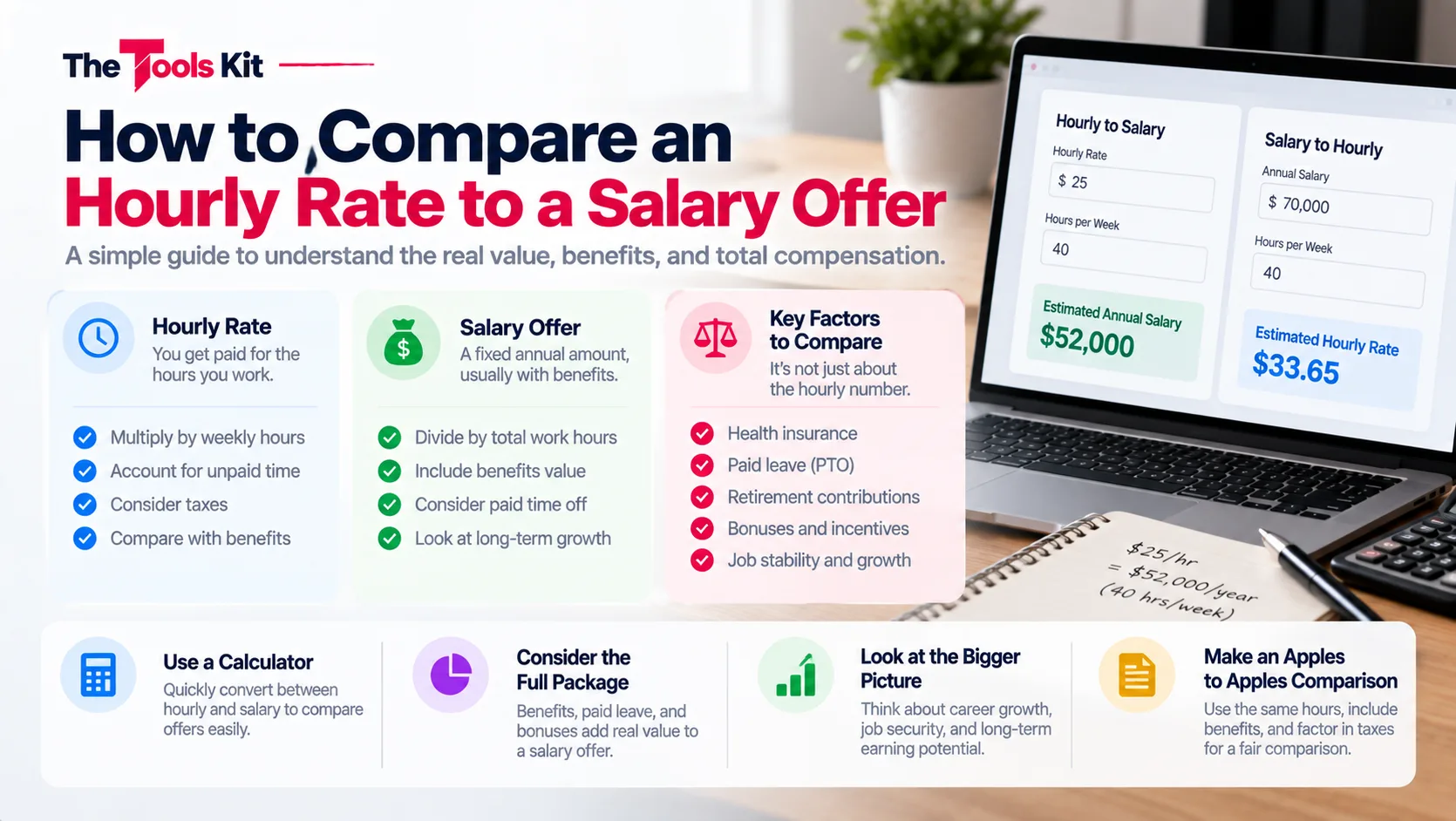
- Full-time work is 40 hours across 52 weeks, or 2,080 hours, so $25 an hour is roughly $52,000 and $75,000 is roughly $36 an hour.
- Non-exempt hourly workers earn at least 1.5 times their rate over 40 hours under the FLSA, and California requires daily overtime past 8 hours.
- An hourly role without paid leave should be valued on about 1,880 hours, not 2,080, making $25 an hour closer to $47,000 a year.
- At $30 an hour with 5 weekly overtime hours, the extra $225 a week adds roughly $11,700 a year that an exempt salaried worker never receives.
You have an hourly contract rate in one hand and a salaried offer in the other. The first step is easy arithmetic. The rest is where the real difference lives.
The 2,080 hour rule
Full time work is conventionally 40 hours a week across 52 weeks:
40 x 52 = 2,080 hours a year
So an hourly rate becomes an annual figure by multiplying by 2,080, and a salary becomes an hourly rate by dividing by it.
- $25 an hour is roughly $52,000 a year
- $75,000 a year is roughly $36 an hour
The Hourly to Salary Calculator does this in both directions and lets you set a different hours per week figure for part time or compressed schedules.
Treat the result as a starting point only. It is a gross figure that assumes you work every one of those 2,080 hours, and that assumption is exactly where the two offers start diverging.
Question 1: Is the hourly role overtime eligible?
This is usually the largest single factor, and it can flip the comparison entirely.
Under the Fair Labor Standards Act, non exempt employees earn at least 1.5 times their regular rate for hours over 40 in a week. Most hourly roles are non exempt. Most salaried professional roles are exempt, meaning hours 41 through 60 are unpaid.
Run the numbers on a realistic week. At $30 an hour with 5 hours of overtime weekly, you are earning an extra $225 a week, roughly $11,700 a year, that a salaried equivalent working the same hours does not get. The Overtime Calculator handles the split.
Some states go further than federal law. California requires daily overtime over 8 hours in a day, not just weekly over 40.
The flip side: overtime you never work is income you never earn. If the role is genuinely 40 hours, this factor disappears.
Question 2: Do you get paid for time you do not work?
Salaried pay usually continues through holidays, sick days, and vacation. Hourly pay often does not.
If a salaried role gives 15 days of paid time off plus 10 public holidays, that is 25 days, 200 hours, that you are paid for without working. An hourly worker at the "equivalent" rate loses roughly $6,000 of that $52,000 by not working those hours.
Which means the honest comparison for an hourly role without paid leave uses 1,880 hours, not 2,080. At that point $25 an hour is closer to $47,000 of realistic annual income.
Question 3: What are the benefits worth?
Employer paid health insurance, retirement matching, and other benefits are real compensation that never appears in a rate. An employer contributing meaningfully to health premiums and matching retirement contributions is adding to total compensation in a way the hourly figure does not capture.
Contract and hourly roles frequently carry none of this, and if you are self employed you also pay both halves of Social Security and Medicare rather than just your own.
Question 4: What does each actually pay after tax?
Gross comparisons hide a lot, particularly across state lines. Two offers with identical gross figures produce different take home pay depending on the state.
A worked comparison
Offer A: $30 an hour, no paid leave, no benefits, regularly 45 hours a week.
- Base: 40 x 52 x $30 = $62,400
- Overtime: 5 hours x 52 x $45 = $11,700
- Total gross: about $74,100
- No paid leave, so unpaid time off reduces this if you take any
- No benefits
Offer B: $70,000 salary, exempt, 20 days paid leave, employer health contribution and retirement match.
- Gross: $70,000
- Paid leave and benefits on top
- No overtime pay for hours beyond 40
On gross alone A wins. Add benefits and paid leave and B is likely ahead, unless the overtime is reliable and you want the hours. There is no universal answer, which is the point: the comparison depends on facts about the specific roles, not on the rate alone.
The checklist
- Convert using 2,080 hours for a first look
- Adjust down to about 1,880 hours if there is no paid leave
- Add expected overtime if the role is non exempt
- Add the value of employer benefits
- Compare take home, not gross, especially across states
The bottom line
The 2,080 hour conversion answers "what is the equivalent number." It does not answer "which offer is better." Overtime eligibility, paid leave, and benefits routinely move the comparison by more than the difference in the headline rate.
Frequently asked questions
Multiply the hourly rate by 2,080, which is 40 hours a week across 52 weeks. So $25 an hour is roughly $52,000 a year. Adjust the hours figure for part time or compressed schedules.
Roughly $36 an hour, dividing by the standard 2,080 hours. If the role has no paid leave, comparing against about 1,880 actually worked hours gives a more realistic picture, which raises the effective rate needed to match.
It depends on overtime eligibility and benefits. Most hourly roles are non exempt and earn at least 1.5 times the regular rate over 40 hours a week, which can add substantially. Most salaried professional roles are exempt and are not paid for extra hours, but usually include paid leave and benefits.
Use 2,080 for a first comparison. If the role has no paid holidays or vacation, about 1,880 hours is more realistic, since roughly 25 days of unpaid time off means 200 hours you are not paid for.
Usually not. Most salaried professional roles are classified as exempt under the Fair Labor Standards Act, meaning hours beyond 40 are unpaid. Non exempt employees, which includes most hourly roles, must be paid at least time and a half over 40 hours a week.