
Key takeaways
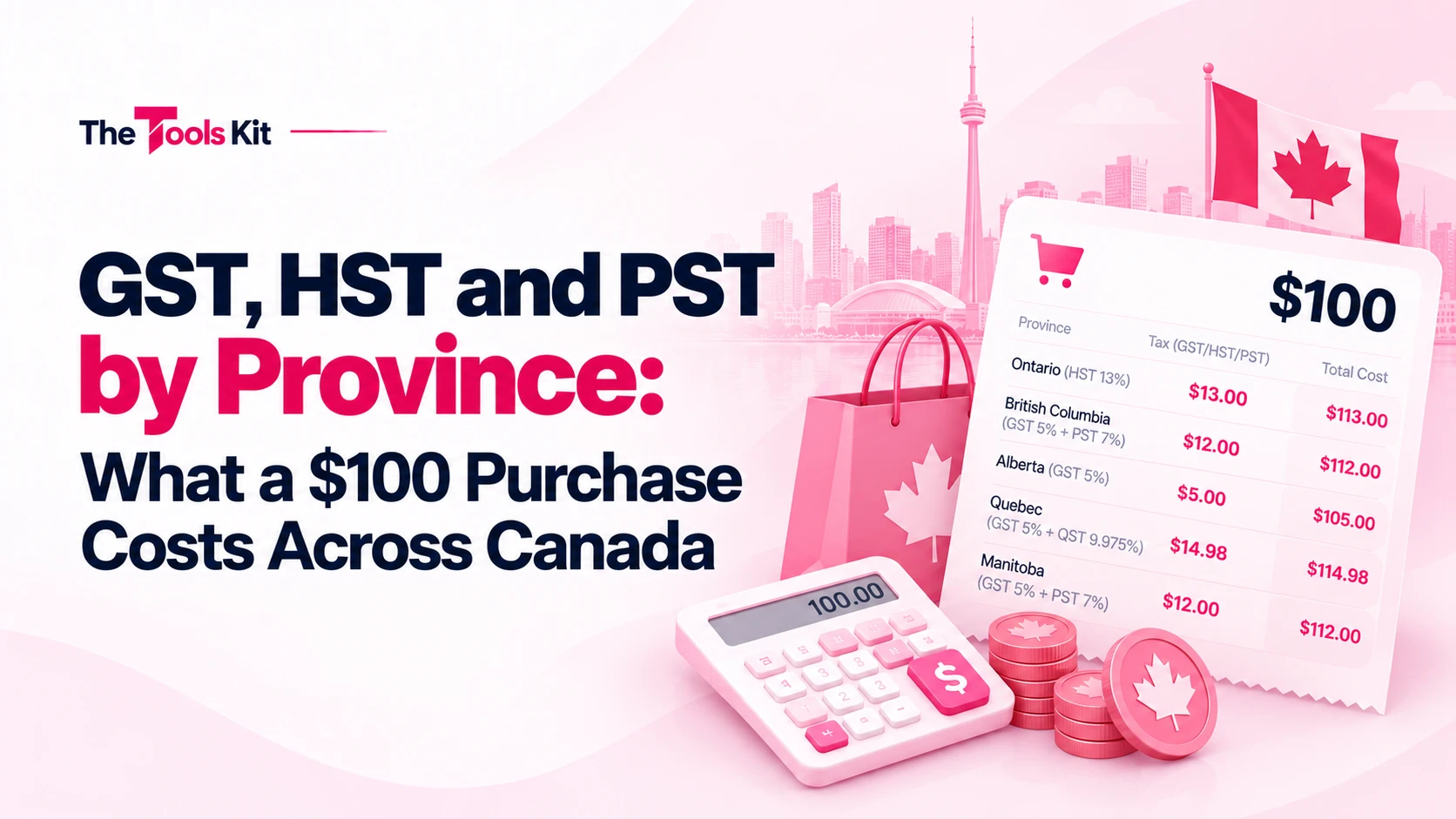
- A $100 item costs $105 in Alberta and the territories, $113 in Ontario, $115 in New Brunswick, Newfoundland and PEI, and $114.98 in Quebec.
- Nova Scotia cut its HST from 15 percent to 14 percent on 1 April 2025, so it no longer matches the other Atlantic provinces.
- Quebec's 9.975 percent QST has been calculated on the pre-GST price since 2013, giving a combined rate of 14.975 percent.
- To extract tax from a total, divide by one plus the combined rate; subtracting 13 percent from $113 gives $98.31, which is $1.69 short.
Canada does not have one sales tax. It has a 5% federal GST that applies everywhere, and then each province decides whether to harmonise with it, add its own tax on top, or add nothing. The result is that the same $100 item rings up at $105 in Alberta and $115 in Nova Scotia's neighbours.
The rates below are those used by our GST/HST calculator, current as of its last verification against the Canada Revenue Agency tables.
Rate table, 2026
| Province / territory | System | Combined rate | $100 item totals |
|---|---|---|---|
| Alberta | GST only | 5% | $105.00 |
| British Columbia | GST + 7% PST | 12% | $112.00 |
| Manitoba | GST + 7% RST | 12% | $112.00 |
| New Brunswick | HST | 15% | $115.00 |
| Newfoundland and Labrador | HST | 15% | $115.00 |
| Northwest Territories | GST only | 5% | $105.00 |
| Nova Scotia | HST | 14% | $114.00 |
| Nunavut | GST only | 5% | $105.00 |
| Ontario | HST | 13% | $113.00 |
| Prince Edward Island | HST | 15% | $115.00 |
| Quebec | GST + 9.975% QST | 14.975% | $114.98 |
| Saskatchewan | GST + 6% PST | 11% | $111.00 |
| Yukon | GST only | 5% | $105.00 |
Nova Scotia cut its HST from 15% to 14% on 1 April 2025, which is why it no longer matches the other Atlantic provinces.
Four systems, one receipt
GST only. Alberta and the three territories charge the 5% federal tax and nothing else. One line on the receipt.
HST. Ontario and the Atlantic provinces fold the provincial portion into a single harmonised tax collected by the federal government. One line, one rate, one remittance for businesses.
GST + PST. British Columbia, Saskatchewan and Manitoba run a separate provincial sales tax with its own rules about what is taxable. Two lines on the receipt, and the PST base is not always identical to the GST base: BC, for example, does not charge PST on most restaurant meals, so a $100 meal there is $105, not $112.
GST + QST. Quebec's QST is 9.975% and, since 2013, is calculated on the price before GST, not on top of it. The combined 14.975% is the two rates added together.
Pulling the tax out of a total
Receipts show a total; expense claims and bookkeeping want the pre-tax amount. Divide the total by one plus the combined rate. A $113.00 Ontario total divided by 1.13 is $100.00, and the $13.00 difference is the HST. A $112.00 BC total divided by 1.12 is $100.00, of which $5.00 is GST and $7.00 is PST.
Do not subtract the percentage from the total. Taking 13% off $113 gives $98.31, which is $1.69 short. The calculator's reverse mode does the division and splits the tax into its federal and provincial parts where they are separate.
Where the rate does not apply
Basic groceries, prescription drugs and most medical devices are zero-rated federally, and provinces generally follow. Children's clothing, books and some other categories are exempt from the provincial portion in several HST provinces through point-of-sale rebates. Used goods sold privately are outside the system entirely. The calculator applies the headline rate to whatever amount you enter; whether an item is taxable is a question for the CRA's guides or your provincial revenue agency.
Cross-border comparisons
American readers who assume Canada's rates are high should check their own state first: our US sales tax calculator covers all 50 states, and a handful of combined state-plus-local rates exceed 10%. The UK equivalent is the VAT calculator, where the standard rate is 20% and the arithmetic is identical.
Frequently asked questions
13%, made up of the 5% federal GST and an 8% provincial portion collected as a single harmonised tax. A $100 purchase totals $113.
Divide the total by one plus the rate. In Ontario, divide by 1.13: a $113 total is $100 before tax. Subtracting 13% from the total gives the wrong answer.
Alberta, Yukon, Northwest Territories and Nunavut. They have no provincial sales tax, so the combined rate is the federal 5%.
Not any more. Since 2013 the 9.975% QST is calculated on the pre-GST price, so the combined rate is a straight 5% plus 9.975%, which is 14.975%.