
Key takeaways
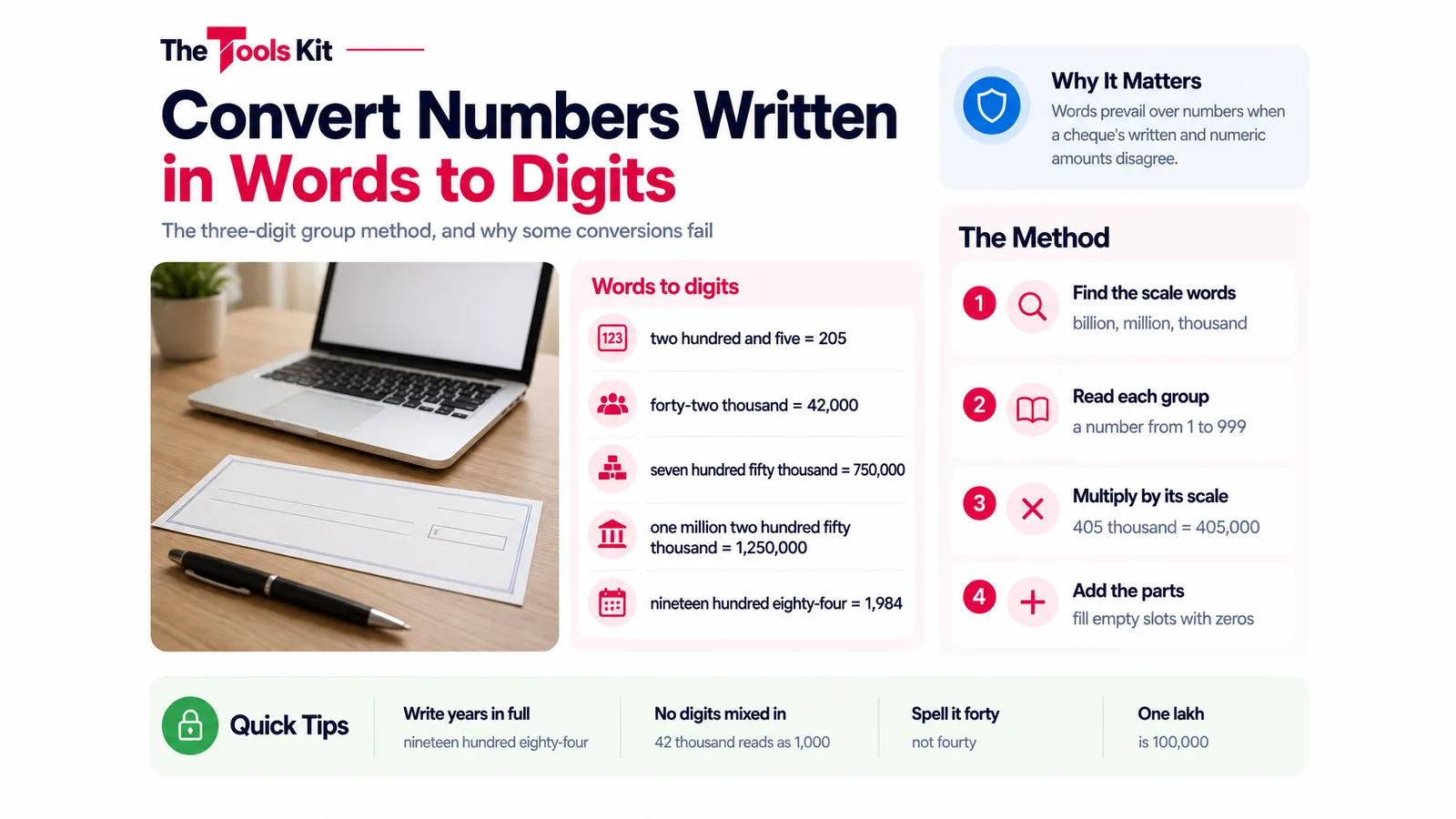
- Every scale word (billion, million, thousand) closes a group of up to three digits; read each group as 1 to 999, multiply by its scale and add.
- Spoken years such as "nineteen eighty-four" convert to 103 word by word; write "nineteen hundred eighty-four" to get 1,984.
- Mixing digits and words fails quietly: "42 thousand" loses the 42 and reads as 1,000, so write the whole number in words.
- In the US, UCC section 3-114 says words prevail over numbers when a cheque's written and numeric amounts disagree.
To convert a number written in words to digits, split it at the scale words (billion, million, thousand), turn each part in front of a scale word into a number from 1 to 999, multiply it by that scale, and add the parts together. "Three million four hundred five thousand twenty" becomes 3 x 1,000,000 plus 405 x 1,000 plus 20, which is 3,405,020. The Words to Number converter does exactly this in your browser, and the rest of this guide covers the method by hand and the inputs that make any converter fail.
The method: groups of three digits
English number words follow the same pattern as the digits. Every scale word closes off a group of up to three digits.
- Find the scale words: billion, million, thousand.
- Read the words in front of each scale word as a number from 1 to 999. "Four hundred five" is 405.
- Multiply each group by its scale and write it in its three-digit slot. 405 thousand fills the thousands slot as 405,000.
- Add whatever comes after the last scale word as the final group. "Twenty" is 20.
- Fill any empty slot with zeros. There is no hundreds group in "twenty", so it is 020.
Inside a group, the teens (eleven to nineteen) are single words, the tens (twenty to ninety) combine with a unit ("forty-two"), and "hundred" multiplies whatever is in front of it. "Seven hundred fifty" is 7 x 100 + 50 = 750.
| Written | Groups | Digits |
|---|---|---|
| two hundred and five | 205 | 205 |
| forty-two thousand | 42 / 000 | 42,000 |
| seven hundred fifty thousand | 750 / 000 | 750,000 |
| one million two hundred fifty thousand | 1 / 250 / 000 | 1,250,000 |
| three million four hundred five thousand twenty | 3 / 405 / 020 | 3,405,020 |
The word "and" adds nothing. British English usually says "two hundred and five" and American English often says "two hundred five"; both are 205.
Years and other spoken shortcuts

People rarely say years the way they write numbers. "Nineteen eighty-four" means 1984, but a word-by-word reading adds nineteen, eighty and four and gets 103. The Words to Number converter reads words that way, so write the year with its scale word: "nineteen hundred eighty-four" gives 1,984, and "two thousand and twenty six" gives 2,026. "Twenty twenty-six" gives 46 for the same reason.
The same applies to "eleven hundred", which is a normal way to say 1,100. That one works, because "hundred" multiplies the eleven in front of it.
Why a conversion fails
The converter understands zero to nineteen, the tens from twenty to ninety, and hundred, thousand, million and billion. Capital letters and hyphens are fine. Anything else stops the conversion with an error that names the word, rather than a guess. These are the inputs that trip it, and how to rewrite them:
| You typed | What happens | Write instead |
|---|---|---|
| a hundred | Unknown word: "a" | one hundred |
| 42 thousand | Digits are stripped, so it reads "thousand" = 1,000 | forty-two thousand |
| fourty two | Unknown word: "fourty" | forty-two |
| twelve dollars | Unknown word: "dollars" | twelve |
| three point five | Unknown word: "point" | Whole numbers only |
| fifteen lakh | Unknown word: "lakh" | one million five hundred thousand |
| one trillion | Unknown word: "trillion" | Largest is 999,999,999,999 |
| twenty-first | Unknown word: "first" | twenty-one |
The "42 thousand" case is the one to watch, because it does not show an error. Only letters are read, so a mixed entry quietly loses its digits. Write the whole number in words.
"Fourty" is the most common misspelling. The number is spelled "forty", even though "four" and "fourteen" keep the u.
Lakh, crore and the billion question
The converter uses the short scale, where a billion is one thousand million (1,000,000,000). That is the meaning in the US and in modern British usage. Older British texts sometimes used "billion" for a million million; if a document is old enough to use that long scale, check the context before trusting the digits.
For Indian amounts, convert lakh and crore into thousand and million first. One lakh is 100,000, so fifteen lakh is 1,500,000 ("one million five hundred thousand"). One crore is 10,000,000 ("ten million"). Going the other way, the Number to Words converter has an Indian system option that writes digits as lakh and crore directly.
Checking an amount written on a cheque or contract
The most common reason to convert words to digits is to check that the two forms of an amount agree. In the US, the Uniform Commercial Code (section 3-114) says that when an instrument such as a cheque has contradictory terms, words prevail over numbers. So if the words and the figures disagree, the words are the amount that counts.
To check one, type the written amount into the converter without the currency word ("one thousand twenty-five", not "one thousand twenty-five dollars") and compare the result with the figures. For cents written as a fraction, such as "and 50/100", convert only the whole-number part and check the fraction by eye.
To produce the words in the first place, use the Number to Words converter. It writes "two thousand twenty six" style text (no hyphens, no "and") in either the Western or the Indian system. For dates and outlines written in Roman numerals, the Roman Numeral Converter handles that separate system.
When to do it by hand
For one number, the group method above takes a few seconds once you have done it twice. For a column of numbers in a spreadsheet, or anything with millions in it, typing each into a converter is faster and avoids misplacing a group of zeros, which is the usual mistake by hand: "two million five thousand" is 2,005,000, not 2,500,000. The converter shows the result with thousands separators and its Copy Number button copies the plain digits without commas, ready to paste into a spreadsheet or form.
Sources
Frequently asked questions
Split the words at billion, million and thousand, read each part as a number from 1 to 999, multiply it by its scale and add the parts. "Forty-two thousand" is 42 x 1,000 = 42,000. A words to number converter does the same steps when you type the words and press Convert.
A converter that reads word by word adds nineteen, eighty and four together. Write the year with its scale word instead: "nineteen hundred eighty-four" gives 1,984 and "two thousand and twenty six" gives 2,026.
No. "Two hundred and five" and "two hundred five" are both 205. British English usually includes "and" and American English often leaves it out; the converter skips the word either way.
One lakh is 100,000 and one crore is 10,000,000. Rewrite the amount in thousand and million before converting, so fifteen lakh becomes "one million five hundred thousand", which is 1,500,000.