
Key takeaways
- A moving cost calculator estimates a typical price range from straight-line distance and home size; it is a budget line, not a quote for your specific move.
- Packing, stairs, storage, specialty items, peak-season dates and insurance sit outside the range and are the usual reasons a quote lands above it.
- Local moves are billed by the hour, so distance-based estimates are least precise there; long-distance moves follow weight and distance, which the calculator models.
- Get three written estimates from an inventory, compare them to the range plus your extras, and question any quote far below the others.
An online moving cost calculator is accurate for the one thing it measures: a typical price range for a move of your size over your distance. It is not accurate for your move, because it has never seen your furniture, your stairs or your dates. Used as a budget range and a sanity check on quotes, it does its job. Used as a quote, it will be wrong by hundreds or thousands of dollars in either direction.
This guide explains what a calculator actually computes, where the gap to a real quote comes from, and a short routine for turning a range into a number you can plan around.
What a moving cost calculator computes
Most calculators, including our moving cost calculator, work from two inputs: the distance between the two cities and the size of the home. The distance is the straight-line (great-circle) distance between the city coordinates, not the driving route, so the mileage shown is usually a little lower than a map gives. The home size stands in for the weight of your belongings: a 2-bedroom home is treated as roughly 5,000 lb, a 3-bedroom as roughly 7,500 lb.
Those two numbers are looked up in a price table calibrated at 50, 200, 375, 750, 1,250, 2,000 and 3,000 miles. Between those points the price is interpolated in a straight line and rounded to the nearest $25. The result is a low-to-high range for full-service movers, and two cheaper tiers derived from it: a moving container (you load, they drive) and freight.
A worked example. For a 2-bedroom home moved about 750 straight-line miles, the calculator shows $2,600 to $4,500 for professional movers, $1,550 to $1,925 for a container and $1,275 to $1,575 for freight. At 200 miles the professional range drops to $2,250 to $3,750. Those are the numbers the tool prints; they are planning figures the site calibrated against published mover pricing, not quotes.
What the range leaves out
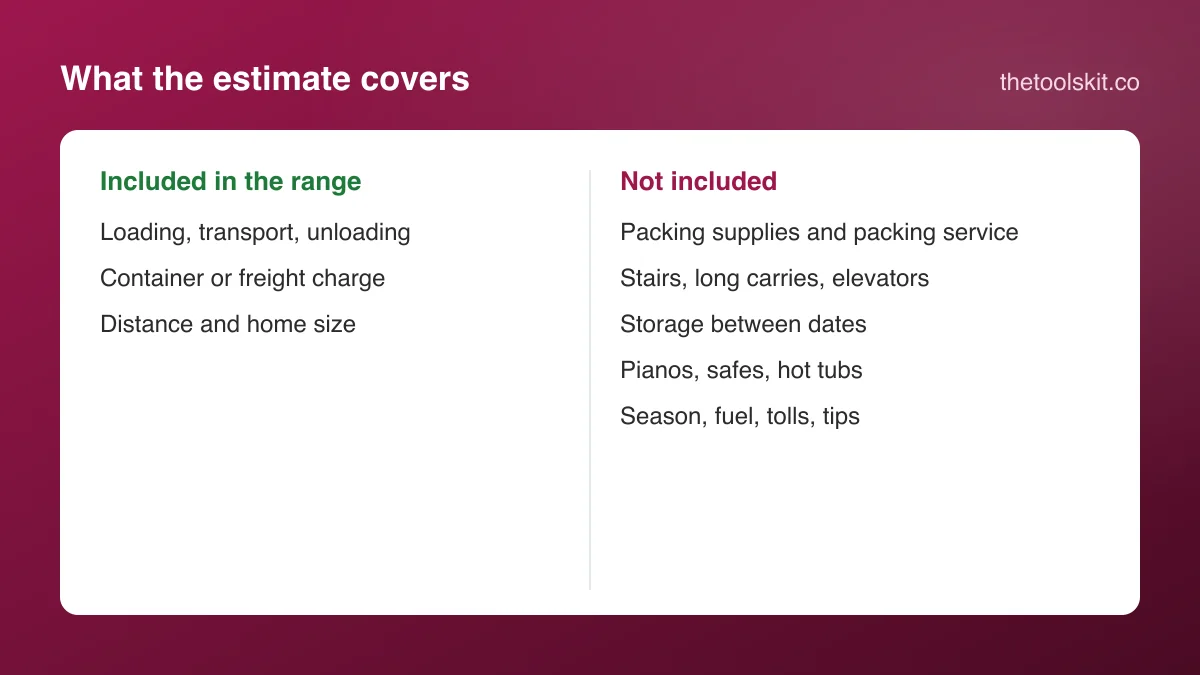
The range covers the move itself: loading, transport and unloading by a crew, or the container or freight charge when you load yourself. Everything below is outside it, and together these items are the usual reason a quote lands above the range.
- Packing. Boxes, tape and paper for a 2-bedroom home run $150 to $300 if you buy them new. A full packing service from the mover is often $500 to $1,500 on top of the move.
- Access. Stairs without an elevator, a long carry from the truck to the door, or a shuttle because a large truck cannot reach the street. Movers charge for each of these.
- Specialty items. A piano, a safe, a hot tub or a large aquarium needs extra people or equipment and is quoted separately.
- Storage. If the new home is not ready, storage-in-transit is charged per month plus a second handling.
- Timing. Late May to September, month ends and weekends cost more. A calculator has no season input.
- Fuel, tolls and tips. Long-distance quotes usually include fuel; local hourly moves may add a travel fee. Tips are customary and come out of your pocket on moving day.
- Insurance. Basic released-value coverage pays 60 cents per pound per item. Full-value protection is an extra line on the quote.
How far off is it, typically?
For a straightforward move, the professional range is wide enough that a competitive binding quote usually lands inside it. Quotes land above the top of the range when the inventory is heavier than the home size suggests (a 2-bedroom with a garage full of tools weighs like a 3-bedroom), when access is difficult, or when the move is in peak season. Quotes land below the bottom when the home is lightly furnished, the move is off-season, or a smaller local company is bidding for the work.
The honest way to read a calculator result is: the middle of the range is a reasonable budget line, the top of the range is what to expect in summer with a few complications, and anything well above the top is a quote you should ask questions about.
A short routine for a usable number
- Run the calculator with the right home size. If you have a packed garage, basement or storage unit, pick one size up.
- Add the extras you know apply: packing, storage, specialty items, difficult access. Write them as separate lines.
- Get three written estimates. Ask each mover for a binding or not-to-exceed estimate based on an in-home or video inventory. A quote given from a phone call without an inventory is a guess, the same as the calculator.
- Compare the quotes to the range. A quote inside the range with your extras added is normal. One far below the others is a reason to check the company's registration and reviews, because low-ball quotes that grow on moving day are the most common complaint in the industry.
- Budget the whole move, not only the mover. Travel, deposits, utility connections, cleaning and the first grocery run belong in the same spreadsheet. Our guide to hidden moving costs nobody budgets for lists them.
Local versus long-distance accuracy
Local moves (under about 100 miles) are usually billed by the hour, with a crew size and a minimum of two to four hours. A distance-based calculator is least precise here, because the bill depends on how long loading takes, not how far the truck drives. Use the calculator's low end as a floor and expect the final figure to follow the hours.
Long-distance moves are billed by weight and distance, which is what the calculator models, so the range tracks real quotes more closely. The remaining gap is almost always inventory weight, so an accurate inventory matters more than anything else you can do.
When the calculator is the right tool
Use it before you have quotes, to decide whether a move is affordable, to compare a container against full service, and to set a budget line. Use it after you have quotes, to spot an outlier. Do not use it to argue with a mover who has seen your home; their inventory beats the calculator's home-size guess every time.
Frequently asked questions
They are accurate as a planning range for a typical move of your size and distance, and not accurate as a quote for your move. The calculator never sees your inventory, stairs, dates or packing needs, so a real quote can sit above or below the range by hundreds of dollars.
The usual reasons are a heavier inventory than the home size suggests, packing services, difficult access such as stairs or a long carry, specialty items, peak-season dates and full-value insurance. None of those are inputs on a distance-and-size calculator, so add them to the range yourself.
No. It uses the straight-line distance between the two cities, so the mileage is usually a little lower than the driving route. Movers price long-distance jobs on weight and distance, and the difference between straight-line and road miles is small next to the inventory weight.
Three written estimates based on an in-home or video inventory is the usual advice. Ask for a binding or not-to-exceed estimate, compare each one to the calculator's range plus your extras, and treat a quote far below the others as a reason to check the company, not as a bargain.