
Key takeaways
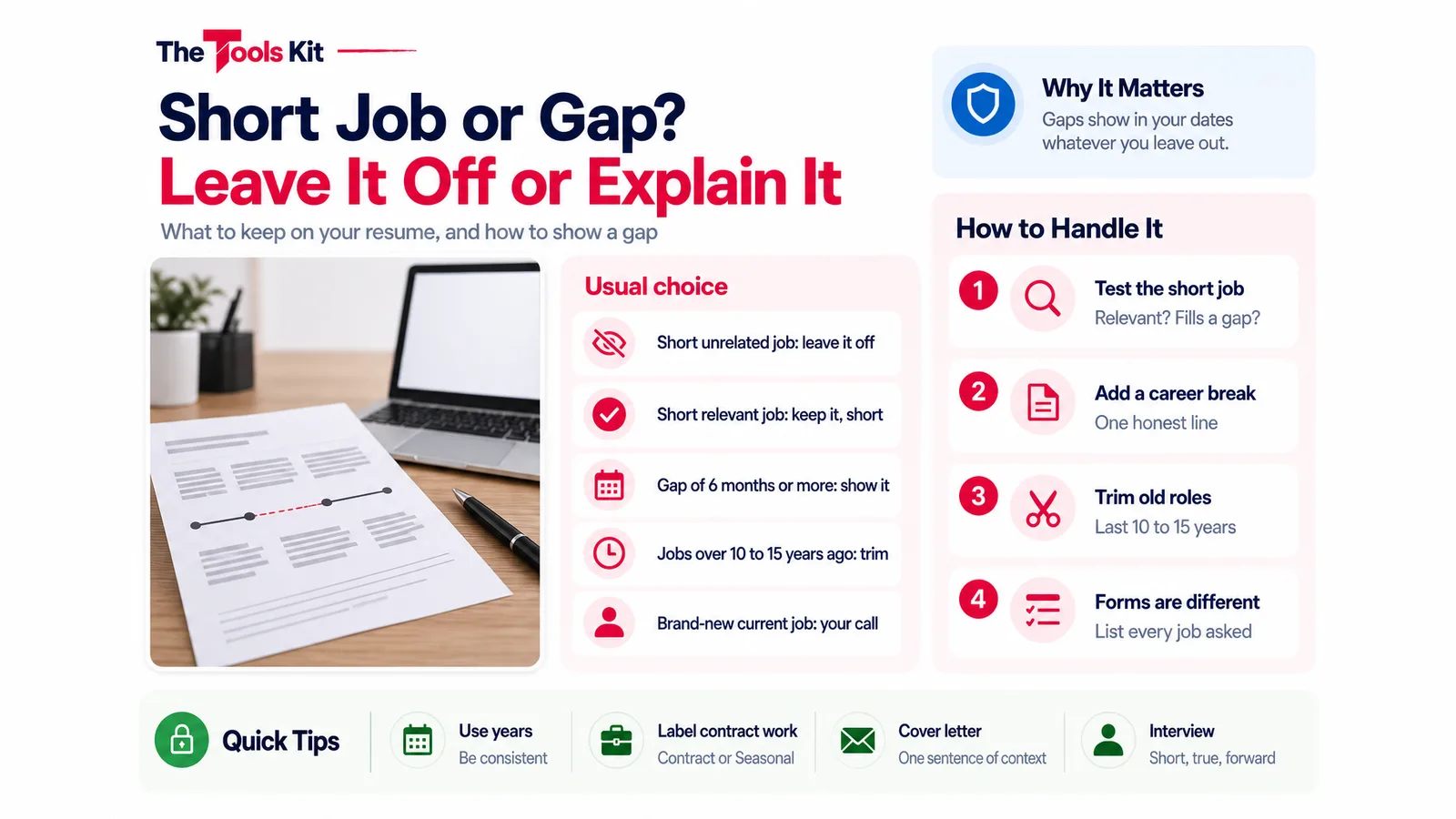
- A resume summarizes relevant experience, so a short or unrelated job of a few months can usually be left off unless removing it opens a long gap.
- Gaps show in your dates whatever you omit, so add a one-line career break entry with an honest reason instead of leaving recruiters to guess.
- Give full detail for roughly the last 10 to 15 years and group older roles, splitting long tenure into one entry per role.
- Application forms that ask for complete employment history are different: list every job they ask for, including the ones your resume leaves out.
You do not have to list every job on a resume. A resume is a summary of the experience that supports the job you want, not a legal record, so a role of two or three months can usually be left off, and older or unrelated jobs can be trimmed. A gap is different: you cannot hide it by leaving things out, so the better move is to show your dates honestly and give the gap one line of context. The exception is any application form that asks for your complete employment history; there you list everything the form asks for.
Below is how to decide each case, the formats that work, and what to say if it comes up in an interview.
A short job: leave it off or keep it?
A job you held for only a couple of months, or are thinking of leaving after a couple of months, is the most common version of this question. Use these tests:
- Does it fill a gap? If removing it leaves an empty stretch of six months or more, keeping it is usually better than creating a gap you then have to explain.
- Is it relevant? A short role in the same field, with a real result you can name, is worth a line. A short role in an unrelated field adds little.
- Is it your current job? If you are job hunting while still employed, you can list the current role even if it is new. Many people leave a very recent job off until it has some substance, and that is a normal choice.
- Was it contract or temporary work? Say so. "Contract" or "Seasonal" next to the title explains a short stint before anyone asks.
If you keep it, give it one or two bullets, not five. The space is better spent on the jobs that carry your story.
A gap: show it with context
Recruiters can read dates, so a missing year shows whether you explain it or not. A single honest line tends to land better than a puzzle. Common, accepted reasons include caring for a family member, health, study, relocation, a layoff followed by a search, travel, or starting something of your own.

| Situation | Usual choice | How to show it |
|---|---|---|
| Job of 1 to 3 months, unrelated | Leave it off | Nothing, unless it fills a gap |
| Job of 1 to 3 months, relevant | Keep it, short | Title, dates, 1 to 2 bullets |
| Gap of 6 months or more | Show it | One line: "Career break, family care" |
| Jobs over 10 to 15 years ago | Trim or group | "Earlier roles" with titles only |
| Brand-new current job | Your call | List it, or add it once it has results |
Three formats handle most gaps cleanly:
- A career break entry. Add it like a job: "Career break" as the title, the dates, and one line on what you did if it is relevant (a course, freelance work, volunteering). In our resume builder you can add this as an experience entry with the role field set to "Career break" and the company left blank.
- Years instead of months. Writing "2023 to 2025" rather than "March 2023 to January 2025" is a common convention and hides nothing that matters for short breaks between jobs. The builder's start and end fields are free text, so years alone are fine. Be consistent across all entries.
- A short note in the cover letter. If the reason needs more than a few words, one sentence in the cover letter is the right place. Our cover letter generator gives you a structure to drop it into.
Long careers: how far back to go
If you have been at one employer for many years, or have a long history, you do not need every role from the start of your career. A common approach is to give full detail for the last 10 to 15 years and either drop older roles or group them under "Earlier experience" with titles and employers only. Long tenure at one company can be shown as several entries under the same employer, one per role or promotion, so the reader sees progress rather than a single block.
This also keeps the resume to a sensible length. If you are unsure whether yours should be one page or two, our guide on one-page versus two-page resumes covers what to cut first.
When you must list everything
Some applications are not a resume at all. Government jobs, security clearances, some regulated industries, and many online application forms ask you to list all employment in a period, sometimes with exact dates. Answer those completely and accurately, including short jobs you leave off your resume. A background check that finds a role you did not list on a form that asked for it causes more trouble than the short job ever would. The resume and the form can differ; the form must be complete.
What to say in the interview
Keep it short, true and pointed forward. Something like: "I took a year out to care for a parent. During that time I kept my certification current, and I am now ready to return full time." For a short job: "The role turned out to be different from what was described, so I moved on quickly. What I am looking for now is..." Then return to what you bring. You do not owe anyone medical or personal detail beyond the general reason.
Check the finished resume
After you edit, paste the text into the resume checker. It looks for contact details, the Summary, Experience, Education and Skills sections, bullet points, first-person pronouns, vague phrases such as "responsible for", and a length between 150 and 1,000 words. It will not judge whether a gap is explained well, but it catches the formatting slips that creep in when you move entries around. If your resume will go through an applicant tracking system, our ATS-friendly format guide covers fonts and layouts that parse cleanly.
Frequently asked questions
Yes. A resume is a summary of relevant experience, not a complete record, so a short or unrelated job can be left off. Keep it if removing it creates a long gap or if it is relevant to the role. On application forms that ask for all employment, list every job the form asks for.
You can. If you are job hunting while employed, listing your current role is normal even when it is new, and many people wait until it has a result worth a bullet. If you leave it off and it is your only job, expect a question about what you are doing now.
Add a short entry such as Career break with the dates and a few words of reason, for example family care, study or relocation. Mention anything relevant you did in that time. Put a longer explanation in one sentence of the cover letter rather than on the resume.
A common approach is full detail for the last 10 to 15 years. Older roles can be dropped or grouped under Earlier experience with titles and employers only. Long tenure at one employer can be split into separate entries per role so promotions are visible.