
Key takeaways
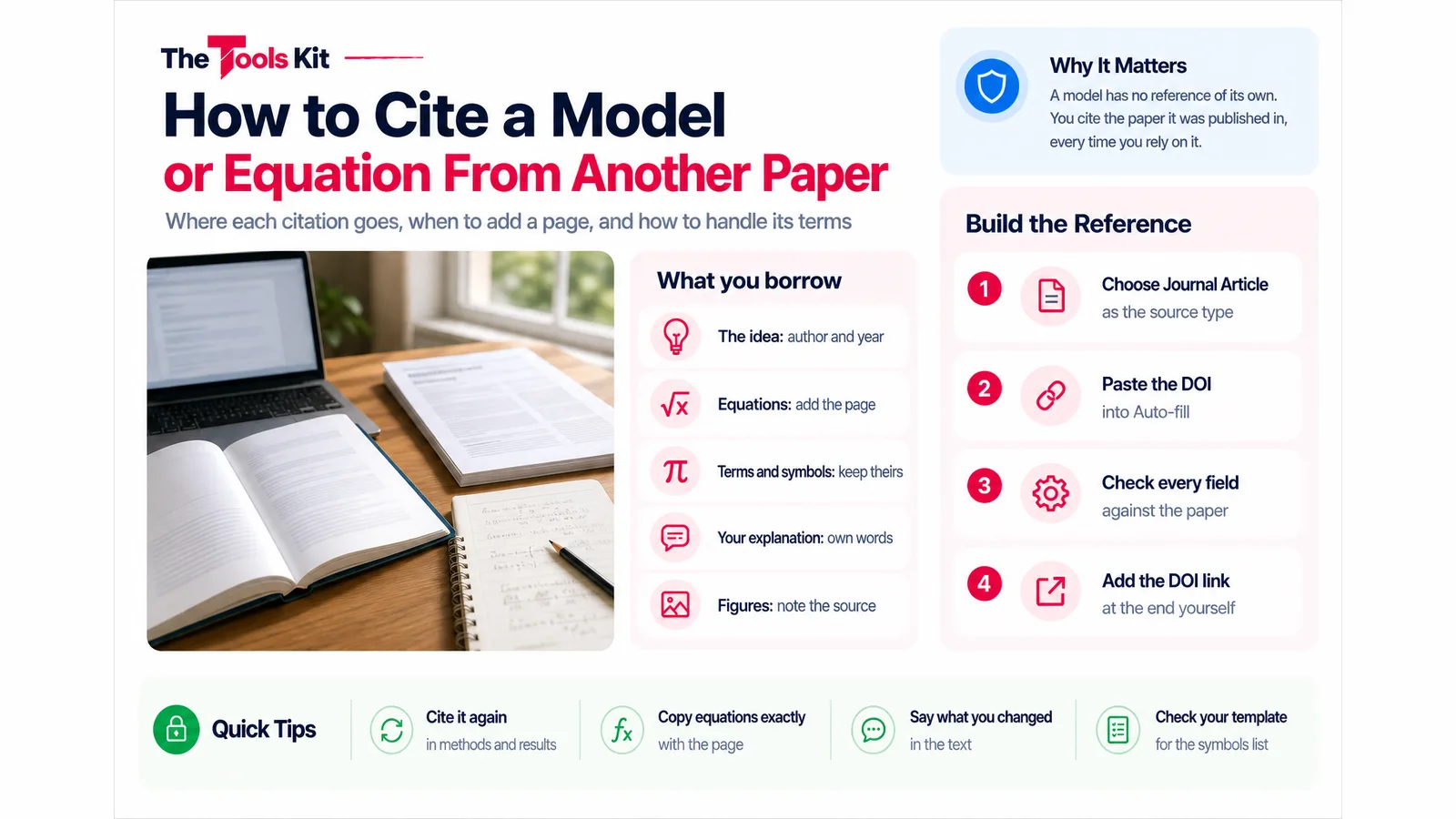
- A model has no reference of its own: you cite the paper, book or report in which the authors published it, every time you rely on it.
- Refer to the model with author and year; add the page number whenever you copy an equation exactly as it appears in the source.
- Explain the model in your own words, keep the authors' symbols and abbreviations, and say clearly whenever you change an equation or term.
- Auto-fill the journal reference from its DOI, check every field, then add the DOI link yourself because the generated entry leaves it out.
You cite a model by citing the paper it was published in. A model has no separate reference of its own: the article, book or report where the authors defined it is the source, and that is the entry that goes in your reference list. In the text, you cite that source each time you rely on the model, and you add a page number whenever you reproduce something exactly, such as an equation. Keep the authors' symbols and term names as they defined them, and write your explanation of the model in your own words.
This guide is for anyone writing a thesis, report or paper that builds on someone else's model: where each citation goes, how much space you can give the model, and what to do with its list of terms.
What citing a model actually covers
When you use a published model you are borrowing three different things, and each is credited a little differently.
- The idea. The model as a whole, what it describes and why it works. When you refer to an idea without quoting it, APA asks only for the author and year, for example (Smith & Lee, 2024). Purdue OWL's summary of APA in-text citation says the page number is needed when you quote or borrow directly, not when you refer to a work as a whole.
- The equations. If you copy an equation as it appears in the paper, you are reproducing the authors' work exactly. Cite it with the page where it appears, for example (Smith & Lee, 2024, p. 6). Keeping their notation also lets a reader check your version against the original.
- The explanation. The sentences the authors used to describe the model belong to them. Explain the model in your own words, and cite the paper after your paraphrase or summary just as you would after a quotation.
The names Smith and Lee here are placeholders; use your source's authors and year.
Where each citation goes
A borrowed model usually appears in several parts of a thesis, and each appearance needs its own citation. One citation in the literature review does not cover an equation that shows up thirty pages later in your methods.

| Where you use it | What to write (APA example) |
|---|---|
| Introducing the model | Smith and Lee (2024) developed a model of resource production in this strain. |
| Copying an equation | Cite after the equation or in the sentence that introduces it: (Smith & Lee, 2024, p. 6) |
| Defining its terms | Terms and symbols follow Smith and Lee (2024). |
| Fitting it to your data | We fitted the model of Smith and Lee (2024) to our measurements. |
| Changing it | Adapted from Smith and Lee (2024); say exactly what you changed and why. |
In IEEE style the source gets a number in square brackets, such as [1], numbered in the order you first cite each source. In MLA, the in-text form is the author's name and the page, for example (Smith and Lee 6).
How much space can you give it?
A page or two on someone else's model is normal in a thesis when the model is central to your work. What matters is that the reader can tell which parts are the authors' and which parts are yours. A clear structure helps:
- What the model is for, in two or three sentences of your own, with the citation.
- The equations, numbered in your thesis's own sequence, with the page in the original for each one you copy.
- The terms and symbols, defined as the authors defined them.
- The assumptions and limits the authors state, so the reader knows when the model applies.
- Why it matters to your study, which is your own contribution and needs no citation.
If you change an equation, rename a symbol or drop a term, say so in the text. A silent change makes it look as if the original authors wrote your version.
Terms and symbols: main list or a separate one?
There is no single rule, and many universities settle it in their thesis template, so check yours first. A practical approach:
- If the model's symbols appear only in that one section, define them in a short table right there and cite the paper in the table title or note.
- If the same symbols come back in your methods, results and discussion, add them to your main list of abbreviations or symbols as well, so a reader who jumps to the results can still look them up.
- Use the authors' abbreviations when they provide them. Inventing new ones for the same quantities makes it harder to compare your work with theirs.
Whether or not you end up fitting the model to your own results does not change this. If you do fit it, cite the paper again in your methods (where you describe the fit) and in your results (where you compare the fit to your data), and say which parameter values came from the paper and which you estimated.
Figures from the paper
A figure you redraw from the paper is still the authors' work, even if you change the colours or the layout. Put a note under it that names the source, and say whether it is reproduced or adapted. Copying a published figure can also raise permission questions, so ask your supervisor or thesis office how your university handles them before you submit.
Build the reference in a minute
Our APA citation generator builds the reference list entry for a journal article:
- Choose Journal Article as the source type.
- Paste the paper's DOI into Auto-fill. The generator looks it up with Crossref and fills in the authors, title, journal, volume, issue, pages and year. Check every field against the paper.
- Copy the reference. The journal entry has no DOI line, so add the DOI as a link (https://doi.org/...) at the end yourself. Purdue OWL notes that APA 7 includes the DOI whenever an article has one.
- For the in-text citation, type the page in the Page box. It prints a single page as "p. 6"; if you cite a range, change "p." to "pp." by hand.
If your department uses another style, the main citation generator covers MLA, Chicago, Harvard and more, and the IEEE citation generator numbers sources for engineering papers. Before you submit, run through our checklist of what citation generators get wrong.
Sources
Frequently asked questions
Cite the paper, book or report where the model was published. Give the author and year when you refer to the model, for example (Smith & Lee, 2024), and add the page when you copy an equation, for example (Smith & Lee, 2024, p. 6). The full source goes in your reference list.
Yes, if you cite them. Copy the equation as the authors wrote it, keep their symbols, and cite the paper with the page where the equation appears. If you change the equation, say what you changed so it is not mistaken for the authors' version.
Yes. Cite it where you describe the fit in your methods and again where you compare the fit with your results. Say which parameter values came from the original paper and which you estimated yourself.
Check your thesis template first. If the symbols appear only in one section, a short table there is enough. If they come back in your methods and results, add them to your main list too, using the authors' own abbreviations.