
Key takeaways
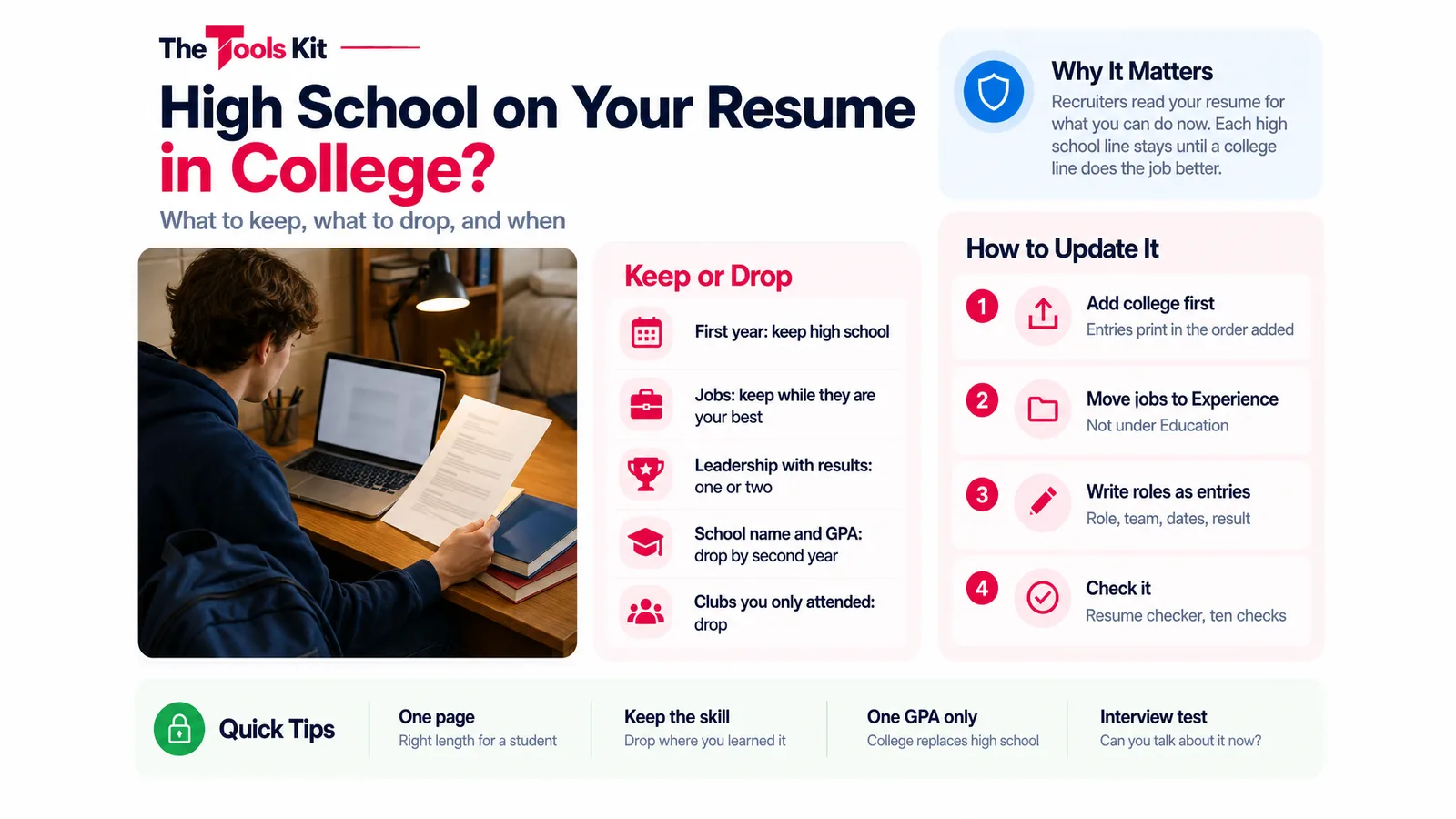
- Keep high school on your resume in your first year of college, then replace each line as college courses, roles and jobs give you stronger evidence.
- Drop the high school name, GPA and class rank by the end of second year, once a college GPA and college experience exist.
- Jobs and leadership roles with results can stay longer than clubs, written as Experience entries with the role, organisation, dates and a result.
- Our resume builder lists entries in the order you add them, so add college before high school and finish in one session.
Keep high school on your resume during your first year or two of college, and drop it once you have college-level experience to show, usually by the end of sophomore year. The exception is anything that still proves something no college entry does yet: a job, a leadership role, a competition result or a skill an employer would care about. Those can stay, written as experience, until something stronger replaces them.
The question comes up because a first-year resume looks thin without high school, and a junior's resume looks dated with it. Here is how to decide line by line, and how to lay out the change in a free resume builder.
What recruiters read high school entries as
A resume answers one question: what can this person do now? In your first year, your college record is a semester or two long, so high school is still recent evidence of what you can do. By the time you are applying for internships after second year, recruiters expect to see college courses, campus roles and summer work. A list of high school clubs at that point suggests you have not added anything since.
So the rule is less about time and more about replacement. Each high school line stays until a college line does the same job better.
What to keep, what to drop, and when
| Item | First year | Second year | Third year and after |
|---|---|---|---|
| High school name and graduation year | Keep | Usually drop | Drop |
| High school GPA, class rank | Keep if strong | Drop | Drop |
| Paid jobs held in high school | Keep | Keep if relevant | Keep only if still your best experience |
| Leadership roles (captain, club president) | Keep | Keep one or two | Drop unless exceptional |
| Awards, competitions, test scores | Keep the notable ones | Keep only notable ones | Drop most |
| Clubs you only attended | Drop | Drop | Drop |

The things worth keeping longer
Jobs. A job is a job wherever you were in school. A part-time retail or restaurant job shows reliability, customer contact and handling money, and it can stay on your resume for years if nothing in college replaces it. Write it under Experience with the employer and dates, not under Education.
Leadership with results. "Team captain" alone says little. "Captain of the varsity swim team, ran warm-ups for 24 swimmers" says what you did. One or two lines like that can stay into second year.
Skills learned in high school. If you learned to code, design, edit video or speak a second language in high school, the skill belongs in your Skills section. The place you learned it does not need to appear at all.
Notable results. A state-level competition placing or a recognised scholarship can stay longer than a club membership, but expect even those to go once you have college results.
What to drop first
- The high school itself, once you have a college GPA and a year of courses. Your college entry already implies you finished high school.
- High school GPA and class rank, once your college GPA exists. Two GPAs side by side invite the question of why you listed the older one.
- Clubs and activities where you only took part. Membership with nothing to show is filler at any stage.
- Anything from before high school. Middle school awards do not belong on a college resume.
How to lay it out in a resume builder
Our resume builder prints its sections in a fixed order: Summary, Experience, Education, Skills. That order suits a student resume, with two things to know:
- Entries appear in the order you add them. There is no drag-to-reorder, so add your college first and your high school second if you keep both, and add your most recent job first under Experience.
- Activities go under Experience. There is no separate activities section, so write a leadership role as an experience entry: the role as the job title, the team or club as the company, the dates, and one or two result bullets.
When you drop high school, use Remove on that education entry. The form is not saved between visits, so finish and use Print / Save as PDF in the same session, and keep your own copy of the text. Nothing you type is uploaded.
If you are building your first resume from nothing, our guide to writing a resume with no experience covers what counts as experience and how to word it. If cutting high school leaves you wondering about length, one page or two answers that: for a student, one page.
Check it before you send it
Paste the finished text into the resume checker. It runs ten rule-based checks in your browser, including whether it finds Education and Experience sections, bullet points, no first-person pronouns and a length between 150 and 1,000 words. It is not an employer's screening system, but it catches the basics. For layout choices that read cleanly in screening software, see ATS-friendly resume format.
A good test for every high school line is simple: if a recruiter asked about it in an interview, would you have something current to say? If yes, keep it. If the honest answer is "that was a while ago", it is time to replace it.
Frequently asked questions
Yes, in most cases. Your college record is only a semester or two long, so your high school, a strong GPA, jobs and leadership roles are still recent evidence. Replace each line as soon as a college course, campus role or summer job does the same job better.
Usually by the end of sophomore year, once you have a college GPA and some college-level experience. Jobs held in high school can stay longer if they are still your best experience, written under Experience rather than Education.
Only in your first year, and only if it is strong. Once you have a college GPA, drop the high school one; listing both makes a recruiter wonder why the older figure is there.
Under Experience, with the employer, your role, the dates and one or two result bullets. A job shows reliability and real responsibility, so it can stay until an internship or campus job replaces it.