
Key takeaways
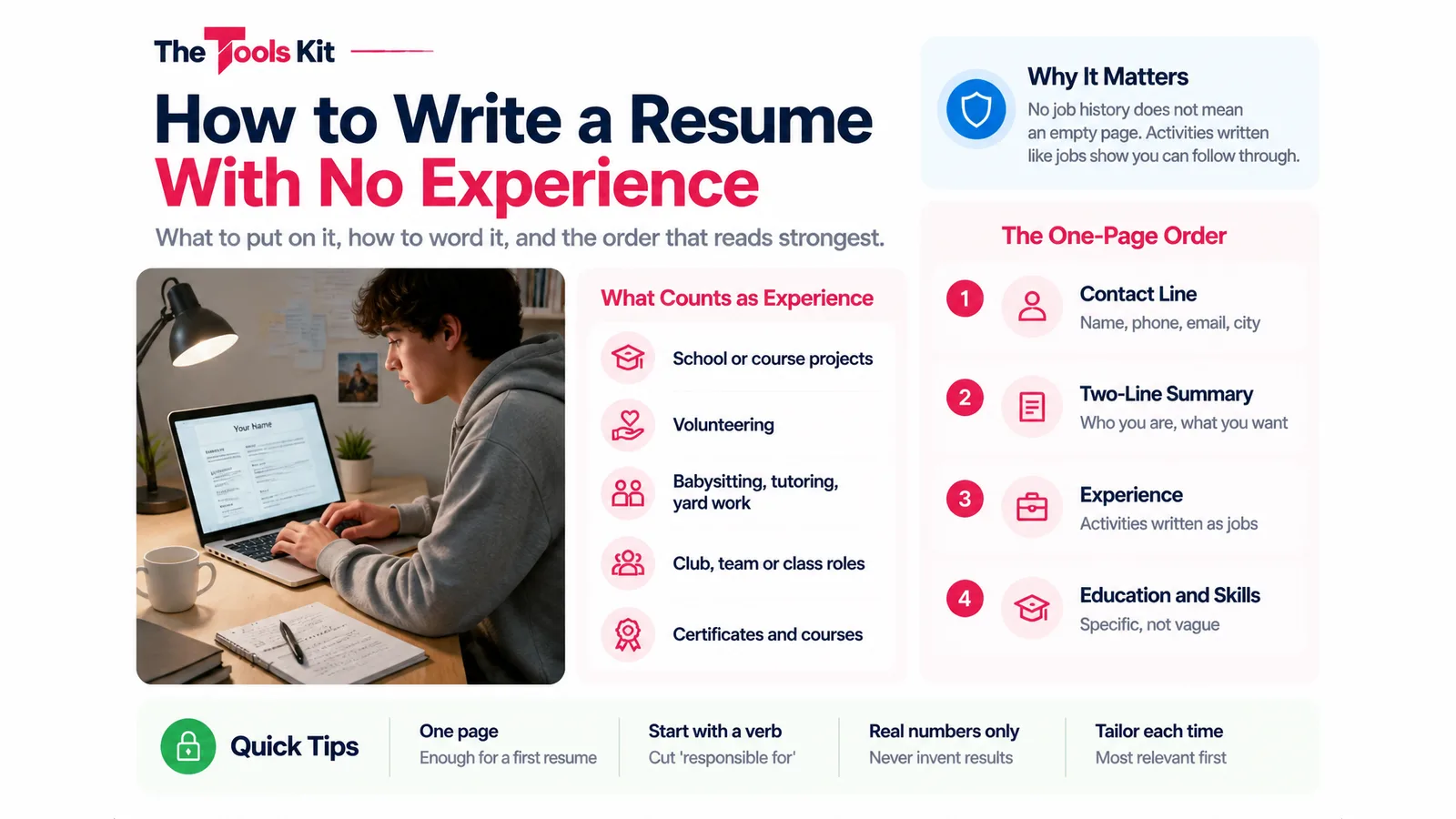
- A first resume uses school projects, volunteering, informal paid work, club roles, certificates and specific skills in place of a job history.
- Give every activity the shape of a job: a role name, an organisation, dates and two or three bullets that start with a verb.
- Order it summary, Experience, Education, Skills on one page, and move the activity closest to each job you apply for to the top.
- Cut phrases like responsible for and helped with, use real numbers only when you know them, and never invent results.
A resume with no work experience is built from what you have done outside paid jobs: school projects, volunteering, informal work such as babysitting or tutoring, club and team roles, and the skills you can prove. Put a two-line summary at the top, then the strongest of those activities written like jobs, then education, then skills. One page is enough, and a short honest page beats a padded one.
This guide covers what counts, how to word it so it reads like experience, and the order that works when you are 16, 19 or just out of school.
What counts as experience when you have never had a job
An employer hiring for an entry-level role is asking two things: can this person show up and follow through, and have they done anything close to this work. Paid employment is one way to answer that. These are others, and they are all fair to list:
- Informal paid work. Babysitting, pet sitting, tutoring, mowing lawns, helping at a family business, selling crafts online. If someone paid you or relied on you, it counts.
- Volunteering. Food banks, school events, religious or community groups, coaching younger kids.
- School and course projects. A group project you organised, a science fair entry, a website you built for a class, a survey you ran and analysed.
- Roles and responsibilities. Club treasurer, team captain, class representative, student newspaper writer.
- Certificates and courses. First aid, food handling, a free online course in spreadsheets or coding.
- Skills you can demonstrate. Languages, typing speed, software you use well, a driving licence if the job involves driving.
Pick the three or four items that are closest to the job you want. A cafe cares about the food handling certificate and the school event you helped cater; an office internship cares about the spreadsheet course and the club budget you kept.

Write each activity like a job entry
The trick that makes a first resume look complete is giving each activity the same shape as a job: a title, an organisation, dates and two or three bullet points that start with a verb and say what happened.
Compare these two versions of the same thing:
| Weak | Stronger |
|---|---|
| Helped at the school bake sale | Bake Sale Organiser, Lincoln High School, Spring 2026 |
| Was responsible for money | Counted and recorded cash for 3 sale days and handed it to the treasurer |
| Did babysitting | Babysitter, private families, 2024 to present |
| Looked after kids | Care for two children aged 4 and 7 after school, twice a week |
The stronger column uses a role name, a place, a time span and a concrete detail. Use real numbers only when you know them: how many days, how many children, how many people came. Do not invent results. "Responsible for" and "helped with" are the two phrases to cut first, because they describe a duty instead of something you did.
The order for a first resume
With little to show, order matters more than usual, because a recruiter often skims only the top third of the page.
- Name and contact line. Name, phone, a professional email address, city. A LinkedIn or portfolio link only if it has something on it.
- Summary, two lines. Who you are and what you want, for example: "Final-year high school student looking for weekend retail work. Reliable, comfortable with customers from two years of babysitting and school event sales."
- Experience. Your three or four strongest activities, written as job entries, most recent first. Keep the heading "Experience" rather than "Work Experience", so volunteering and projects sit there honestly.
- Education. School, expected graduation date, and a strong grade or relevant course if you have one.
- Skills. Six to ten specific items: languages, software, certificates. Skip vague ones like "hard-working" and "team player"; your bullets should show those.
If your education is the strongest thing you have (a relevant degree or a high grade in the subject), it is fine to put it before Experience. For most first resumes, activities written as jobs make the stronger opening.
Build it in a free resume builder
Our free resume builder follows the same order: a summary, then Experience entries with a job title, company, location, start and end dates and one bullet per line, then Education, then a comma-separated Skills list. Three templates are available (Classic, Modern and Minimal), the preview updates as you type, and you export with Print / Save as PDF. Everything is built in your browser, nothing you type is uploaded, and there is no paywall at download, which is a common trap covered in our guide to resume builders that charge at download.
Two practical notes for a first resume. In the Experience entry, the Job title field holds your role ("Volunteer", "Babysitter", "Project lead") and the Company field holds the organisation, family or school. A section with nothing typed in it is left off the page, so an unused second entry will not show up blank.
Check it before you send it
Paste the finished text into our resume checker. It runs ten checks in your browser, including an email and phone number, Summary, Experience, Education and Skills headings, bullet points, first-person pronouns, vague phrases like "responsible for", and a length between 150 and 1,000 words. A first resume that uses the Experience heading for projects and volunteering passes the section check instead of failing it.
For layout rules that help with application tracking systems (fonts, file type, headings), see our ATS-friendly resume format guide. If the application asks for a letter as well, the cover letter generator uses the same live preview and PDF export.
Common mistakes on a no-experience resume
- Two pages. One page holds everything a first resume needs. A second page of filler signals the opposite of what you want.
- A long objective statement. Two lines are enough. Spend the space on bullets.
- Listing every school subject. Name only the courses that relate to the job.
- A photo or personal details such as age or marital status, unless the job ad or the local norm asks for them.
- The same resume for every job. Reorder your activities so the most relevant one is first each time. It takes five minutes and makes the biggest difference a first-time applicant can control.
Frequently asked questions
List school projects, volunteering, informal paid work such as babysitting or tutoring, club or team roles, certificates and specific skills. Write each activity like a job entry with a title, organisation, dates and two or three bullets that start with a verb.
Yes. A first resume rarely has enough relevant material for more than one page, and a recruiter skims the top third first. A short, specific page reads better than a long one padded with school subjects and vague traits.
Yes. Use the heading Experience rather than Work Experience and list them like jobs: Babysitter, private families, with dates and bullets. Employers hiring for entry-level roles read these as evidence that you are reliable and can be trusted with responsibility.
You can, but most first resumes are stronger with one, because projects and volunteering written as entries show what you have done. Resume checkers, including ours, also look for an Experience heading, so using it for these activities avoids a failed check.