
Key takeaways
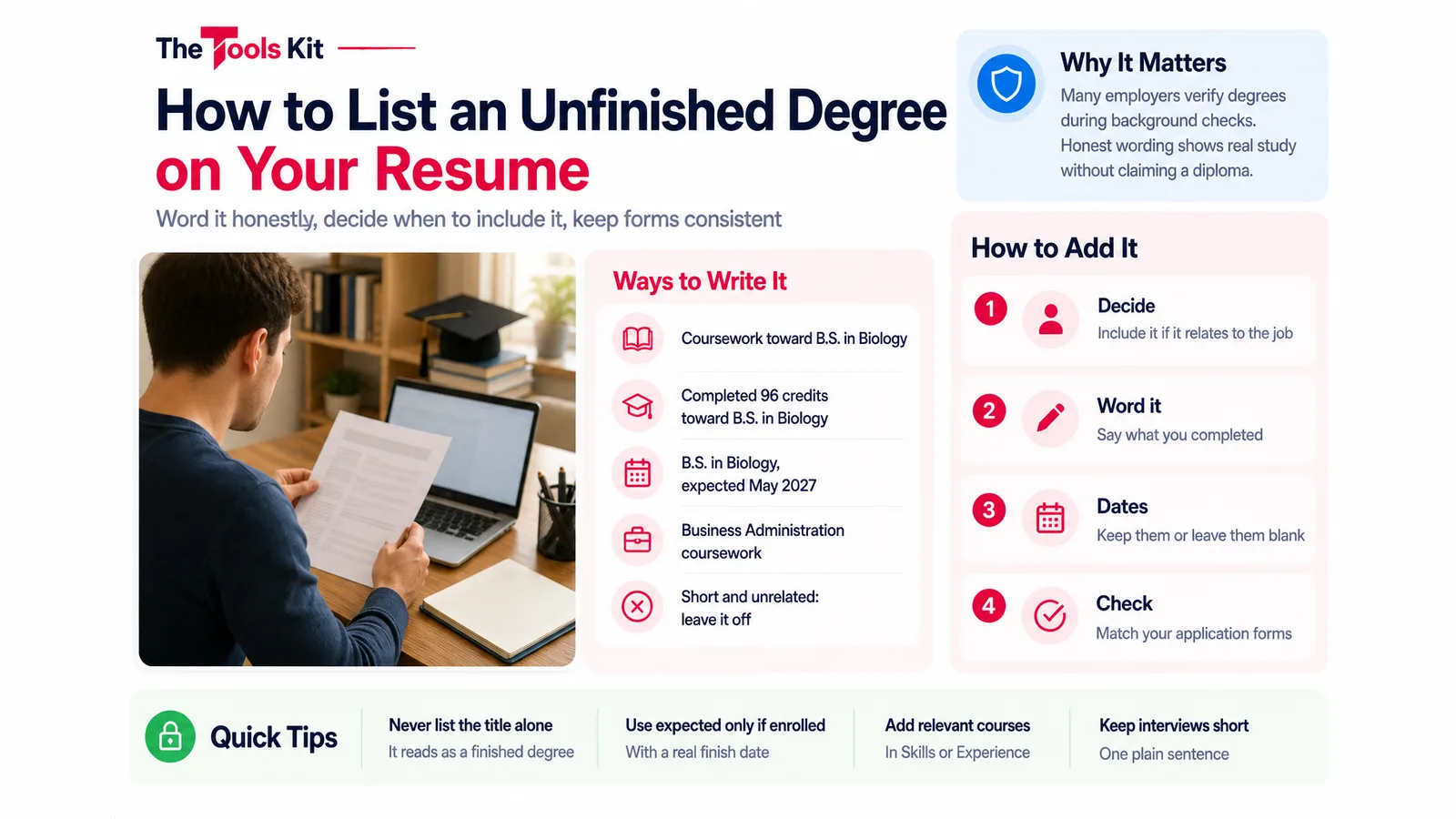
- Write what you completed, such as coursework toward a B.S. in Biology, so nobody can read the line as a finished degree.
- Include unfinished study when it relates to the job, explains time spent in college, or shows a skill you still use.
- On application forms pick Some college, no degree or your highest finished level, and keep it consistent with your resume.
- In our resume builder, type the wording into Degree and leave Start and End blank if you want the dates hidden.
List the school, the subject you studied and what you actually completed, and word it so nobody could read it as a finished degree. "Coursework toward a B.S. in Biology" or "Completed 96 credits toward a B.S. in Biology" are both honest and both show real study. Never list the degree title on its own, and never pick "Bachelor's degree" on an application form if you did not graduate. Many employers verify degrees during background checks, and a degree that turns out not to exist can cost you the offer.
People in this spot usually worry about two things: that an unfinished degree looks like failure, and that leaving it off leaves a strange gap. Neither has to be true. Here is how to decide, how to word it, and how to set it up in a free resume builder.
Should you include it at all?
Include it when it does one of these jobs:
- It relates to the work you want. Two years of engineering courses help an application for a technician role, even without the degree.
- It explains time. If you spent three or four years in college, leaving it off can make those years look empty. Listing the study fills the gap with something true.
- The posting asks for some college. Some job ads list "some college" or "college coursework" as a plus. Your entry is the evidence.
- It shows a skill you still use. Languages, accounting, programming or lab work count even if the diploma never came.
Leave it off when it was a short spell long ago, it has nothing to do with the job, and your work history already covers that time. A single semester from fifteen years ago rarely adds anything for an experienced professional changing fields.
Ways to write it
| Your situation | How to write it |
|---|---|
| You left a few years ago | Coursework toward B.S. in Biology, State University, 2018 to 2021 |
| You know your credit count | Completed 96 credits toward B.S. in Biology, State University |
| You are enrolled and will finish | B.S. in Biology, State University, expected May 2027 |
| You studied long ago | State University, Business Administration coursework |
| It was short and unrelated | Leave it off |

Use "expected" only if you are actually enrolled and have a real finish date. Writing an expected date for a degree you have no plan to return to is the same problem as listing the degree itself.
Dates: keep them or drop them?
Dates are optional in the Education section. Keep them when they fill a period that would otherwise look like a gap, or when the study is recent. Drop them when the study was long ago and the dates would only draw attention to how long ago it was. Either way, the wording above makes clear what you completed, so the dates are not hiding anything.
If you have dates on every other entry and none on education, that is fine. Recruiters read the Education line for what you studied, not for the years.
Show what you learned, not what you missed
The study is more useful when it points at something specific:
- Relevant courses. Add one line such as "Courses: Statistics, Organic Chemistry, Technical Writing" if they match the job.
- Projects and lab work. A capstone, a research assistant role or a lab job can go under Experience as its own entry, with a result.
- Skills. Anything you learned and still use belongs in your Skills section, where it counts whether or not you finished.
If you left college to work, your work history already explains why. You do not need to write a reason on the resume itself.
Application forms and interviews
Online application forms often ask for your highest level of education from a list. Pick the option that matches what you completed, such as "Some college, no degree" or your high school diploma or GED. Do not choose "Bachelor's degree" to get past a filter. The form and the resume should tell the same story.
If an interviewer asks, one plain sentence is enough: what you studied, that you left to work or for family or money reasons, and what you have done since. Then move on to the job. Most interviewers care far more about the last few years than about why a degree stopped.
How to set it up in the resume builder
Our resume builder has five fields per education entry: Degree, School, Location, Start and End. They are plain text, so:
- Type the honest wording into Degree, for example "Coursework toward B.S. in Biology". Always fill this field: if Degree is empty and School is filled, the preview prints the word "Degree" as a placeholder.
- Leave Start and End blank to hide the dates. The preview only shows the dates you fill in, so blank fields print nothing.
- Put relevant courses in Skills or under Experience. There is no separate coursework field.
Everything runs in your browser and nothing you type is uploaded. The form is not saved between visits, so finish in one session and use Print / Save as PDF. Then paste the text into the resume checker, which looks for an Education section among its other checks.
If your college years also left a gap in your work history, our guide to a short job or employment gap on your resume covers how to handle it. For a layout that screening software reads cleanly, see ATS-friendly resume format.
Sources
Frequently asked questions
Not if the wording says what you completed. "Coursework toward a B.S. in Biology" is honest. Listing "B.S. in Biology" on its own, or choosing Bachelor's degree on an application form, claims something you do not have.
Keep them when they fill time that would otherwise look like a gap, or when the study is recent. Drop them when it was long ago. The dates are optional either way, as long as the wording makes clear you did not graduate.
Choose the option that matches what you completed, such as Some college, no degree, or your high school diploma or GED if that is the highest level offered. Keep it consistent with your resume.
Only if you are enrolled again and have a real finish date. An expected date for a degree you have no plan to finish misleads the reader in the same way as listing the degree itself.