
Key takeaways
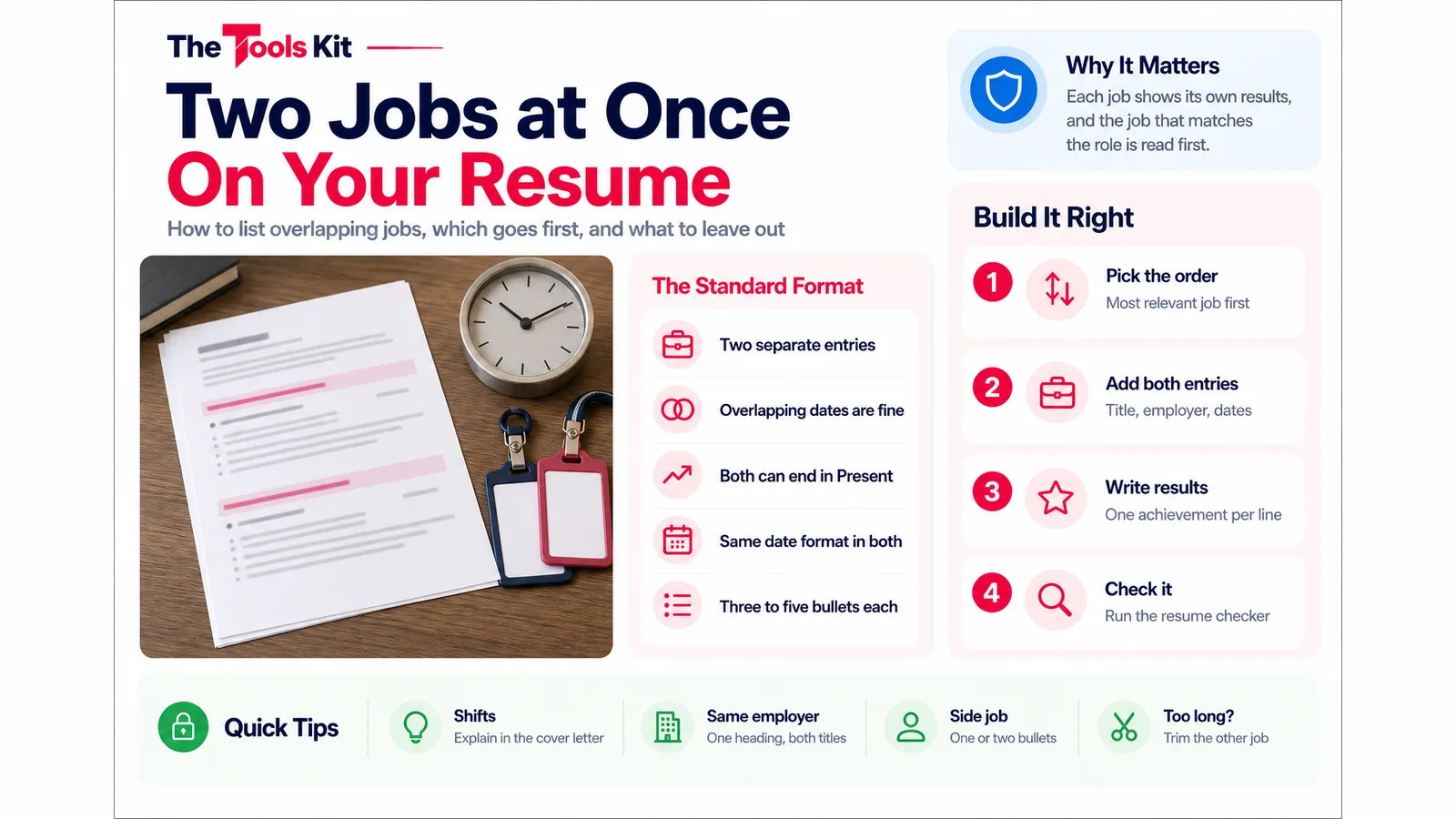
- List two current jobs as two separate entries, each with its own title, employer, dates and bullets, and let the dates overlap with both ending in Present.
- Put the job most relevant to the role you want first and give it the most bullets; trim the other to two or three relevant results.
- Keep shift and schedule details for the cover letter or interview, where you can explain which job you would leave and when you could start.
- In the resume builder, add the job you want first before the other, because entries appear in the order added and cannot be reordered.
If you hold two jobs at the same time, list them as two separate entries in your experience section, each with its own job title, employer and dates, and let the dates overlap. Both can end in "Present". You do not need to explain the overlap on the resume itself; a recruiter who reads two current jobs understands what it means. The choices that matter are which job goes first, how much detail each one gets, and whether a short note about schedule helps or hurts.
This guide covers the standard format, the cases where a different layout works better, and how to answer the questions that two jobs tend to raise.
The standard format: two entries, overlapping dates
Most resumes list experience in reverse chronological order, newest first. Two current jobs break that rule only slightly, because both are "newest". Give each its own block:
- Job title, then employer, then location
- Dates, written the same way in both entries, for example "Mar 2024 - Present" and "Aug 2025 - Present"
- Three to five bullets of results for that job only
Keep each entry self-contained. Mixing duties from both jobs into one list makes it hard to tell what you did where, and it hides the fact that you are trusted with two roles.
Write the dates in a consistent format across the whole resume. Month and year is the usual choice. Many applicant tracking systems read dates to work out how long you held each role, and a consistent, plain format is easier for them to parse than mixed styles or dates tucked into a table. Our guide to an ATS-friendly resume format explains what parses cleanly.

Which job goes first
When both jobs are current, you choose the order. Use this rule: put the job that is more relevant to the role you are applying for first. If they are equally relevant, put the one with the earlier start date first, so the reader sees the longer tenure.
An example. Someone works as a warehouse shift supervisor and as a quality assurance supervisor at another company, and wants to move into quality roles. The QA job goes first, with the most bullets. The warehouse job goes second, with two or three bullets that show what a hiring manager in quality cares about: leading a team, safety checks, meeting targets.
For a different target, swap them. The resume is tailored to the job you want, not a log of your week.
Should you mention the shifts?
Usually, keep the shift out of the job title and leave the schedule for the conversation. A recruiter reading two full-time jobs may wonder whether you could take a third, so put the reassurance where you can explain it:
- In the cover letter, one sentence is enough, for example that you have managed two supervisory roles across different shifts and are ready to move to a single full-time position.
- In the interview, be ready to say which job you would leave and when you could start.
There is one case where a short label helps: when the schedule itself proves something the target job needs, such as overnight leadership for an operations role. Then a plain note under the title, like "Overnight shift, team of 12", is fine. Use only numbers that are true for your job.
When a different layout works better
| Your situation | How to list it |
|---|---|
| Two jobs at two employers | Two separate entries, overlapping dates, most relevant first |
| Two roles at the same employer | One employer heading, both titles under it with their own dates |
| A side job unrelated to your target | A short entry with one or two bullets, or leave it off |
| Freelance or gig work alongside a job | One entry such as "Freelance designer", listing clients only if allowed |
| Resume already over two pages | Keep the full detail for the relevant job and trim the other |
Leaving a job off is allowed. A resume is a selection, not a complete employment history. If a background check or application form asks for every employer, list it there; on the resume, include what supports the application. Our guide on one-page versus two-page resumes helps with deciding what to cut, and if you are weighing whether a short role belongs at all, see short jobs and gaps on a resume.
Building it in the resume builder
Our resume builder handles overlapping jobs without any special setting:
- Fill in the first experience entry with the job you want first. Entries appear in the order you add them, and they cannot be reordered later.
- Press + Add experience for the second job.
- Type the dates as free text in both entries, for example "2024" and "Present". There is no date picker, so the format is up to you; keep it the same in both.
- Write one achievement per line in each bullets box.
- Press Print / Save as PDF when the preview looks right.
The builder runs in your browser and saves nothing, so finish in one sitting or keep your text in a document as you go.
Check it before you send it
Paste the finished text into the resume checker. It runs ten rule-based checks, including whether your bullets start with a bullet character and whether vague phrases like "responsible for" slip in. Two jobs often means two sets of duty-style bullets, so it is a good catch.
Then read the experience section once more as a recruiter would. Each job should show a result, not just a duty, and the job that matches the application should be the one they read first.
Frequently asked questions
Yes. If you still work both jobs, both entries end in Present. Overlapping dates are normal and recruiters read them as two concurrent jobs. Write the dates in the same format in both entries, such as month and year.
Put the job that is more relevant to the role you are applying for first and give it the most bullets. If both are equally relevant, list the one you started earlier first so the longer tenure is easy to see.
Usually not. Keep the shift out of the title and explain your schedule in one sentence of the cover letter or in the interview. Add a short note only when the schedule itself proves something the target job needs.
Yes. A resume is a selection of relevant experience, not a full employment history. If an application form or background check asks for every employer, list it there, but on the resume include what supports the application.