
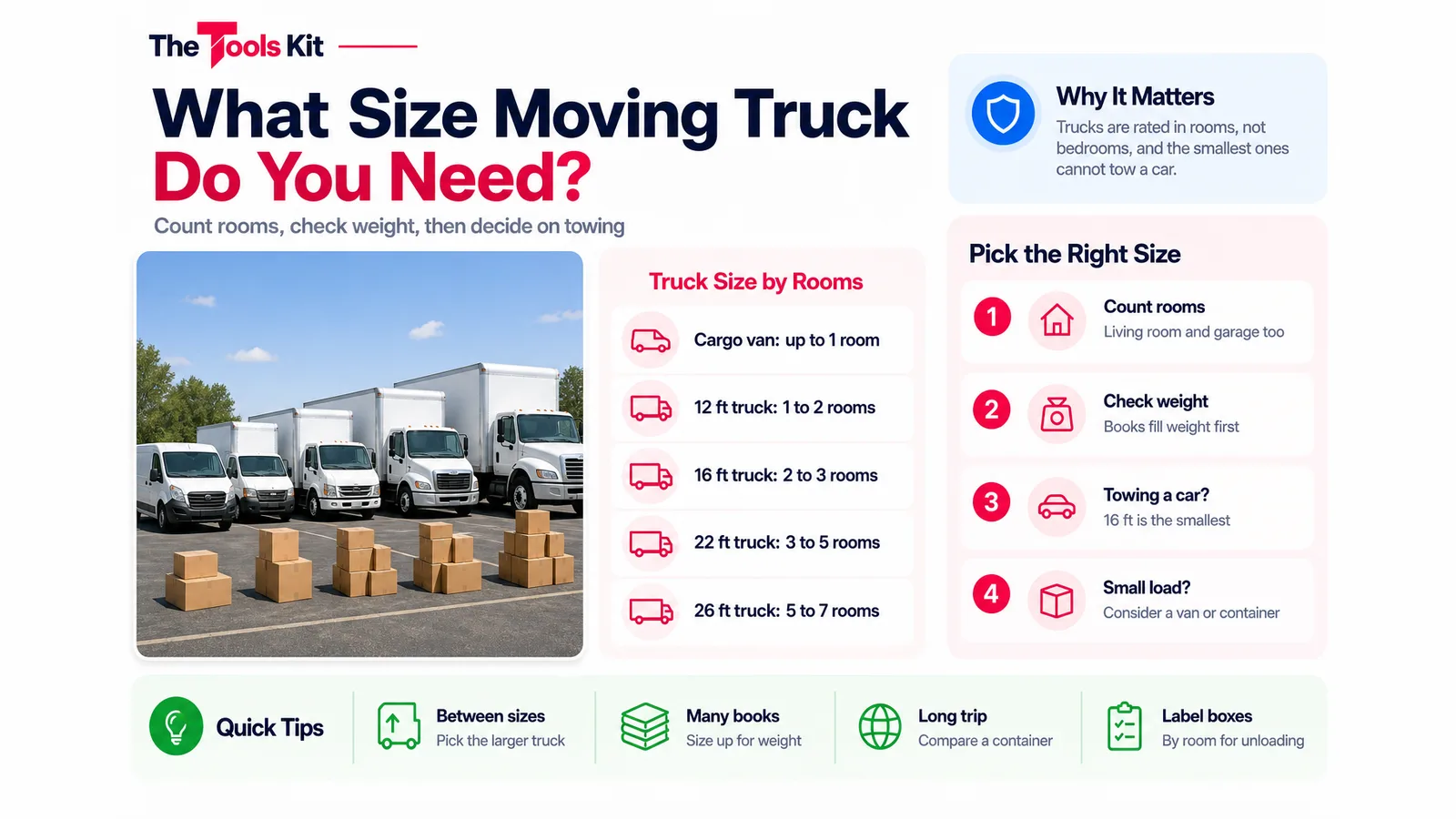
Key takeaways
- Moving trucks are rated in rooms, not bedrooms, so count the living room, dining area, office and garage before you pick a size.
- Check load capacity as well as space: a 16 ft Penske truck carries up to 4,300 lb, while the 22 ft and 26 ft trucks carry up to 10,000 lb.
- If a car has to come with you, the 12 ft truck is out, because Penske's 16 ft truck is the smallest one that can tow.
- For a small load over a long distance, a cargo van or a moving container can cost less and avoid needing a second driver.
To pick a moving truck, count rooms rather than bedrooms, then check two things the size label does not tell you: how heavy your load is, and whether you need to tow a car. Rental companies rate trucks by rooms. Penske, for example, rates its 16 ft truck for two to three rooms and describes it as the right size for a one-bedroom apartment, because a one-bedroom place also has a living room and a kitchen.
This guide lays out the common sizes, the two checks that most often change the answer, and when a van or a moving container makes more sense than a truck.
Truck sizes at a glance
These are Penske's published figures for its personal rental fleet. Penske notes that capacities and dimensions are approximate and vary by manufacturer, and other companies' trucks of the same length will be close but not identical.
| Vehicle | Rooms | Loading space | Load capacity | Can tow a car |
|---|---|---|---|---|
| Cargo van | Up to 1 | 404 cu ft | 3,500 lb | No |
| 12 ft truck | 1 to 2 | 450 cu ft | 3,100 lb | No |
| 16 ft truck | 2 to 3 | 800 cu ft | 4,300 lb | Yes |
| 22 ft truck | 3 to 5 | 1,200 cu ft | 10,000 lb | Yes |
| 26 ft truck | 5 to 7 | 1,700 cu ft | 10,000 lb | Yes |
Penske describes its 22 ft truck as right for a one to three bedroom home and its 26 ft truck for a three to five bedroom home.

Step 1: Count rooms, not bedrooms
Walk through your home and count every space that has furniture in it: each bedroom, the living room, the dining area, a home office, and a garage, shed or storage unit. A kitchen counts if you are taking a table, chairs or appliances.
A typical one-bedroom apartment with a living room and a dining table is three rooms, which already sits at the top of the 16 ft truck's range. Many sizing mistakes come from reading "2 bedrooms" and picking a truck rated for two rooms.
Then adjust for how full each room is. A sparsely furnished room with a mattress and a dresser is not the same as a room with a sectional sofa, a bookcase and a desk. If you are between two sizes, the larger truck is usually the safer pick: running out of space on moving day means a second trip or leaving things behind.
Step 2: Check the weight, not just the space
Room ratings assume ordinary furniture and boxes. Some loads fill the weight limit before they fill the box, and books are the classic example: a wall of book boxes takes little floor space but adds a lot of weight.
Look at the load capacity column. A 16 ft truck carries up to 4,300 lb, while the 22 ft and 26 ft trucks carry up to 10,000 lb. For a rough sense of scale, our moving cost calculator plans a 1-bedroom home at about 2,500 lb and a 2-bedroom home at about 5,000 lb. Those are the site's planning figures, not a weighing, but they show why a full 2-bedroom home with heavy furniture can outgrow a 16 ft truck on weight alone.
If you have hundreds of books, solid-wood furniture, a piano or a gym setup, size up.
Step 3: Decide whether you are towing a car
This is the check that surprises people with small loads. Penske's 12 ft truck is listed as not towing compatible, and its 16 ft truck is the smallest one you can tow a vehicle behind with a car carrier or tow dolly.
So if you only have a bed, a dresser and some boxes but need the car to come with you, the 12 ft truck is not an option. You are choosing between:
- A 16 ft truck with a tow dolly or car carrier.
- Driving your car yourself and fitting the furniture in a van or a small truck, if someone else can drive it.
- Driving your car yourself and shipping the furniture in a moving container.
When a van or a container beats a truck
For a very small load, a cargo van rated for up to one room may be all you need, and it drives like a large car. For a long trip with a small load, a moving container often makes sense: you load it, the company drives it, and you do not need a second driver.
As an example, our calculator puts a studio-size move of about 750 miles at $1,550 to $2,650 with full-service movers and $925 to $1,150 with a container. Run your own route in the moving cost calculator, and see our guide on movers vs containers vs truck rental for what a rental quote leaves out, such as fuel and lodging.
Before you book
Write down your room count, any heavy items and whether a car is coming. Those three facts pick the size in most cases. Once you have the truck, labeling boxes by room makes unloading much faster; our guide on labeling moving boxes with QR codes shows a simple way to do it with the free QR code generator.
Sources
Frequently asked questions
Usually a 16 ft truck. Penske rates its 16 ft truck for two to three rooms and calls it the right size for a one-bedroom apartment, because a living room and dining area count as rooms too. Size up for heavy items like many boxes of books.
Count the rooms first. A two-bedroom home with a living room and dining area is often four rooms, which fits Penske's 22 ft truck, rated for three to five rooms and up to 10,000 lb. A lightly furnished place may fit a 16 ft truck.
Not at Penske. Its 12 ft truck is listed as not towing compatible, and the 16 ft truck is the smallest one you can tow a vehicle behind with a car carrier or tow dolly. Check the rules at other rental companies before you book.
Yes, through weight rather than space. Book boxes are small but heavy, so a large collection can reach a truck's load capacity before the box is full. A 16 ft Penske truck carries up to 4,300 lb, and the 22 ft and 26 ft trucks up to 10,000 lb.