
Key takeaways
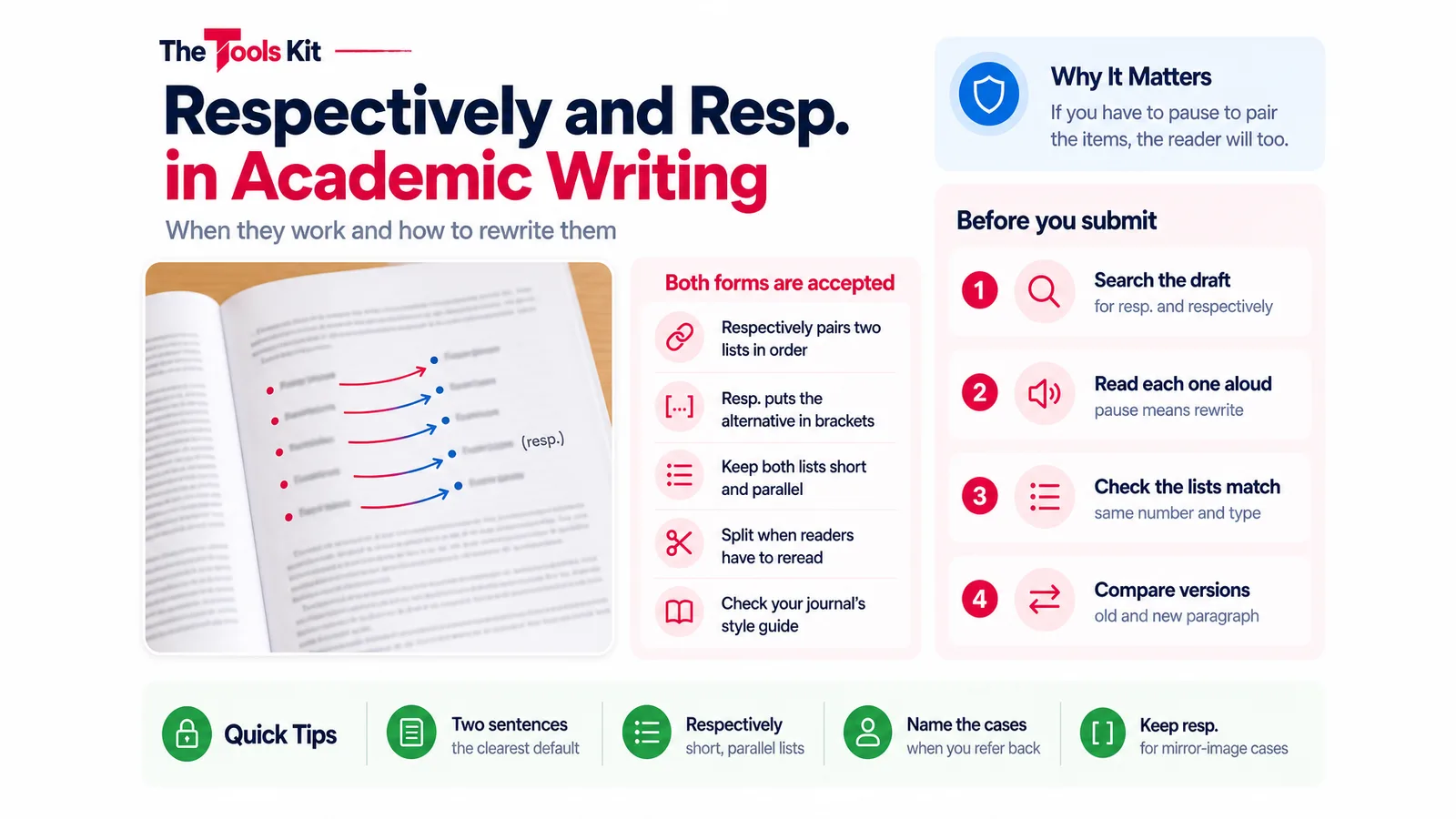
- Respectively and resp. are both accepted; respectively pairs two lists in order, while resp. puts the alternative in brackets beside each item.
- Keep the paired lists short and parallel; once a reader has to count items or reread, split the sentence into two plain ones.
- Readability tools count the full stop in resp. as a sentence end, so drafts heavy with abbreviations get scores that look easier than the text is.
- Keep resp. for exact mirror-image cases your readers expect, use it once per sentence, and rewrite whenever a reviewer stumbles over it.
Yes, both are accepted. "Respectively" tells the reader that two lists match up in order: the first item with the first, the second with the second. The abbreviation "resp." does the same job inside one sentence, usually in brackets, and you will meet it mostly in technical papers. Neither is wrong. The question is whether the reader can follow the pairing without going back to reread, and for anything longer than two short pairs the honest answer is often no. When that happens, the fix is to split the sentence, not to find a cleverer abbreviation.
This guide shows how each form works, when it helps, when it hurts, and three ways to rewrite a sentence that leans on it too hard.
How respectively works
"Respectively" sits at the end of a sentence with two parallel lists and says: match these in order.
The first and second samples were heated to 40 and 60 degrees, respectively.
The reader pairs "first" with "40" and "second" with "60". It saves repeating the verb, which is the whole point. The pairing only works when both lists have the same number of items and the items are parallel (the same kind of word or phrase), which is the idea Purdue OWL describes as parallel structure.
Two habits keep it readable:
- Keep both lists short. Two items each is easy. Three is fine if the items are short. Four or more makes the reader count.
- Put the comma before it when it closes the sentence: "40 and 60 degrees, respectively." Your journal's style guide overrides any general rule, so check it.
How resp. works
The abbreviation is a different construction, not just a shorter spelling. Instead of two lists, the alternative is written in brackets right next to the item it replaces:
The first (resp. second) sample was heated to 40 (resp. 60) degrees.
Read it twice: once with the words outside the brackets (first sample, 40 degrees), once swapping in the bracketed words (second sample, 60 degrees). It is compact, and in a proof or a definition where the two cases are mirror images (positive and negative, upper and lower, left and right), it can be the clearest way to state both at once without writing the same sentence twice.
It has costs. The reader has to hold two sentences in mind and assemble the second one. Readers who are new to the field, or who read English as a second language, may not know the abbreviation at all. And many text tools treat the full stop in "resp." as the end of a sentence, which matters more than it sounds (see below).

What a readability checker does with resp.
We ran one sentence written three ways through our readability checker. The version with "respectively" is one 24-word sentence: Flesch Reading Ease 55.6, grade 11.5. The version with "(resp. second)" and "(resp. 60)" came out at 85 and grade 3.3, which looks far easier. It is not. The checker splits sentences at a full stop followed by a space, so each "resp. " is counted as a sentence ending and one sentence becomes three short ones. Writing the same content as three real sentences gives 80.9 and grade 4.1.
Two practical lessons follow. First, if your draft is full of "resp.", "e.g." and "i.e.", treat any readability score as too optimistic. Second, the three-sentence version is the one that genuinely reads at that level, because the reader does not have to rebuild a hidden second sentence. The checker also lists every sentence over 25 words, which is a quick way to find the long "respectively" sentences worth splitting.
Three ways to rewrite a resp. sentence
Take a sentence like: "A value cannot round up (resp. down) if any input is negative (resp. positive)."
| Approach | Rewrite | Use it when |
|---|---|---|
| Two sentences | A value cannot round up if any input is negative. It cannot round down if any input is positive. | The default. Clearest for every reader. |
| Respectively | A value cannot round up or down if any input is negative or positive, respectively. | The lists are short and parallel. |
| Name the cases | Case 1: rounding up is impossible when an input is negative. Case 2: rounding down is impossible when an input is positive. | You refer back to the cases later. |
The first rewrite is longer by a few words and much easier to read. In most papers that is a good trade, and editors rarely object to clarity.
When to keep resp.
Keep it when your field uses it routinely and your readers expect it, when the two cases are exact mirror images, and when writing both out would make a definition or theorem statement noticeably longer than the idea deserves. Use it once per sentence, not three times. If a reviewer or co-author stumbles over it, that is the answer: rewrite.
A short checklist before you submit
- Search the draft for "resp." and "respectively". Our word counter shows the total length, so you can see what splitting costs.
- Read each one aloud. If you have to pause to pair the items, the reader will too.
- Check the lists match in number and type of item.
- Run the grammar checker for mechanical slips such as double spaces or a space before a comma, which bracketed asides tend to collect. It does not judge whether "respectively" is the right choice; that part is yours.
- Compare versions. Paste the old and new paragraph into text compare to see exactly what changed before you send it to a co-author.
If your problem is the opposite one, sentences that lean on quotations because the technical wording feels impossible to change, our guide on a paper that reads like a string of quotes covers it.
Sources
Frequently asked questions
Yes, it is a recognised abbreviation for respectively and appears in technical papers. It asks more of the reader than two plain sentences, so use it for short mirror-image cases and check your journal's style guide.
Respectively pairs two lists in order at the end of a sentence. Resp. puts the alternative in brackets next to each item, so the reader builds a second sentence by swapping in the bracketed words.
When respectively closes the sentence, it is usually set off with a comma, as in 40 and 60 degrees, respectively. Your target journal's style guide has the final word on punctuation.
Readability tools often treat a full stop followed by a space as a sentence ending. Each resp. then splits one long sentence into several short ones, so the score looks easier than the text really is.