
Key takeaways
- Reuse equations, symbols, units and standard technical terms exactly as they are with a citation; quotation marks are only for wording that matters.
- Quote a formal definition once, then use the term and explain it in your own words instead of quoting it every time it appears.
- Synonym swapping keeps the source sentence structure, so close the source and write from your understanding before comparing against the original.
- Open each paragraph with your own claim and bring sources in as support, so the argument still reads in your order and voice.
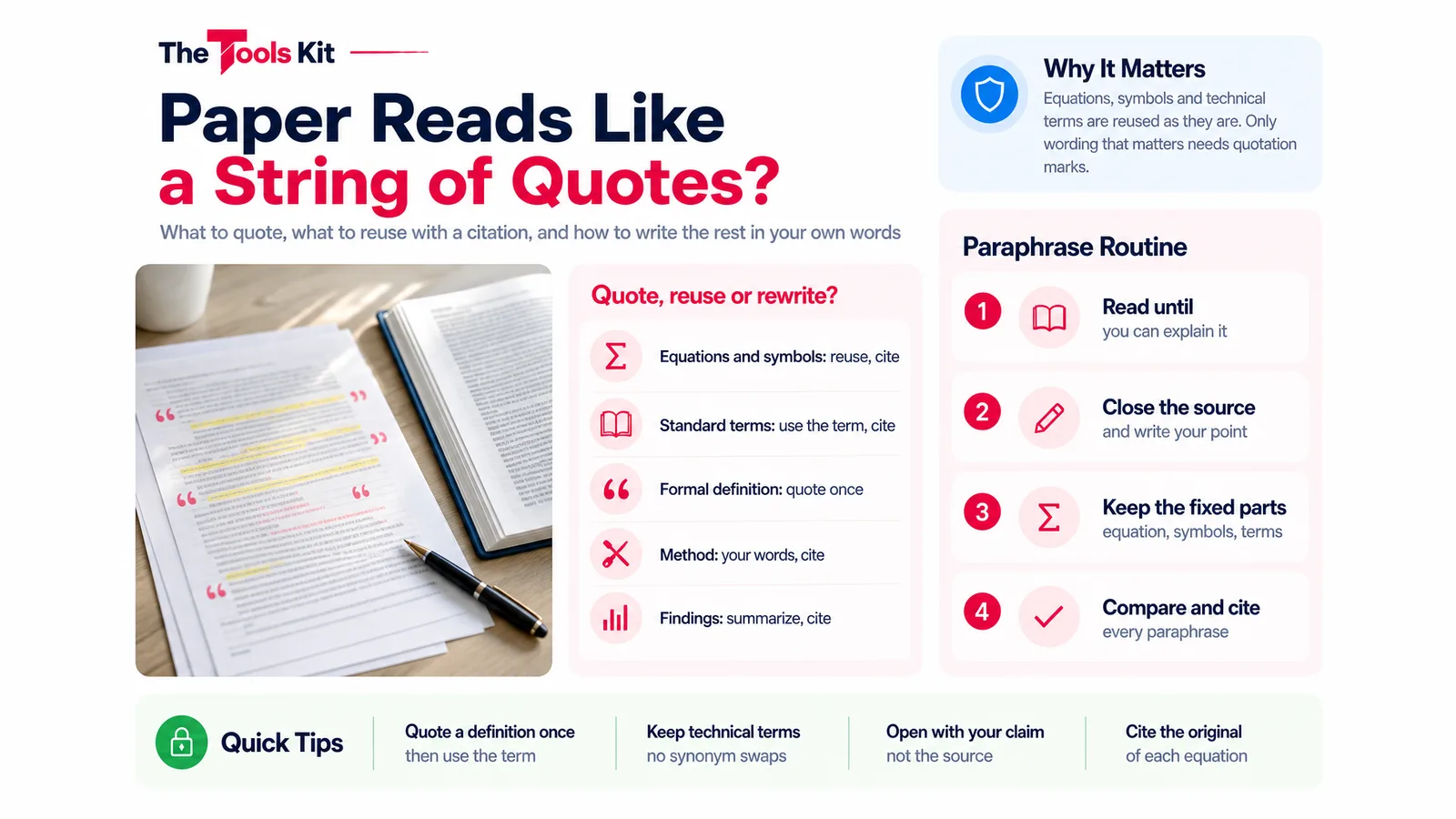
If your draft reads like a string of quotes, you are probably quoting things that do not need quotes. Equations, symbols, technical terms and the names of methods are reused as they are, with a citation, because nobody expects you to reword them. Only a sentence whose exact wording matters needs quotation marks. Everything else (what a method does, why it matters, what a paper found) goes in your own words, with a citation, and that is where your voice comes back.
This guide sorts the parts of a technical source into those three groups and gives a short routine for writing the rest.
Plagiarism and copyright are two different questions
Plagiarism is about credit: presenting someone else's ideas or words as yours. A citation fixes it. Copyright is about copying someone else's expression: their particular sentences, paragraphs and figures. A citation does not, by itself, make copying long passages acceptable, which is why a draft built from quotes feels wrong even when every quote is cited.
The useful part for science writers is what copyright does not cover. In the United States, the Copyright Office's circular on works not protected by copyright says the law excludes any idea, procedure, process, system, method of operation, concept, principle or discovery, however it is described. Protection extends only to the original expression. The same circular says words and short phrases, such as names and titles, are not protected. So the method, the equation as a mathematical relationship, and the name of a technique are free to use; what you should not lift is someone's paragraph explaining them.
This is general information, not legal advice. Rules differ by country, and a publisher or repository can set its own terms on top. If you are reproducing a whole figure, table or long passage, check the license or ask your library.
What to quote, what to reuse, what to rewrite
Sort every borrowed piece into one of these rows before you write the paragraph around it.

| From the source | What to do |
|---|---|
| Equations, symbols, units | Reproduce them as they are and cite the paper they come from |
| Standard terms and method names | Use the term; cite where it was introduced or defined |
| A formal definition whose wording matters | Quote it once, cite it, then explain it in your own words |
| A method or algorithm | Describe the steps in your own words or your own pseudocode, and cite |
| Background, findings, arguments | Summarize or paraphrase, and cite |
Two habits cause most of the quoting. The first is quoting a definition every time the term appears. Quote it once, then use the term. The second is quoting the explanation of an equation. Reproduce the equation, then explain each variable in your own sentences, in the order your reader needs.
Do not swap synonyms for technical words
A technical term is chosen because it means one exact thing. Replacing "variance" with "spread", or "convergence" with "approach", changes the meaning and can make your paper wrong. Keep the terms; change everything around them.
The same goes for word-swapping tools. Our paraphrasing tool is a basic synonym rewriter: it has a small dictionary of 71 common words (such as good, important, however, very) and swaps some of them at Light, Medium or Heavy strength. Words outside that list, including technical terms, are never touched, and sentence structure is never changed. That makes it handy for varying your own repetitive wording, but it cannot turn a source passage into yours. A source sentence with three words swapped still follows the source too closely, which is often called patchwriting.
A paraphrase routine that keeps your voice
- Read the passage until you can explain it. If you cannot say what it means without looking, you are not ready to paraphrase it.
- Close the source. Write what the passage means for your argument, not what it says. Start from your point, for example "This matters for our setup because...", rather than from the author's first words.
- Keep the fixed parts. Bring back the exact equation, symbols and terms from the source.
- Compare. Open the source again and check that you have not reused its sentence shape or a run of its wording. If you have, quote that part or rewrite it.
- Cite it. A paraphrase needs the same citation as a quote.
To check step 4 quickly, put the source passage in one box of our text compare tool and your version in the other, one sentence per line. It compares line by line and marks lines that match exactly, so any sentence it shows as identical is a copy that needs quotation marks. A line with a word or two changed shows as different, so still read those pairs side by side.
Build paragraphs around your claim, not the source's
A paragraph that opens with "Smith (2021) defines X as..." hands the paragraph to Smith. Open with the claim you are making, and bring the source in as support: what you need from it, the equation, and the citation. Your paragraphs should still make sense in your order if someone removed the source names.
When the same idea appears in many papers in the same words, that wording is usually just the standard way to say it in your field. Worrying that someone, somewhere, has written an identical sentence is not useful. What matters is that you did not copy your sentences from a source, and that every borrowed idea, equation and result is cited.
Getting the citations right
Cite the original source of an equation or model where you can, not only the paper where you first saw it. Our guide to citing a model or equation from another paper covers how to word that in APA, MLA and IEEE. The citation generator formats the reference list entries in 11 styles, and what citation generators get wrong lists the checks to run on its output before you submit.
Sources
Frequently asked questions
No. Equations, symbols and units are reproduced as they are with a citation to the paper they come from. Quotation marks are for wording. Explain each variable in your own sentences after the equation instead of quoting the source's explanation.
A standard term defined the standard way is not plagiarism when you cite where it comes from. If you copied the source's sentence, quote it once and cite it. If you wrote it yourself and it still sounds similar, that is usually just the standard wording in your field.
Not on its own. A synonym tool keeps the source's sentence structure and only swaps common words, so the result still follows the source too closely. Close the source, write from your understanding, then use a tool only to vary your own wording.
In the United States, the Copyright Office says ideas, procedures, processes, systems, methods, concepts, principles and discoveries are excluded from copyright, and only the original expression is protected. You still need to cite them to avoid plagiarism. Rules vary by country.