
Key takeaways
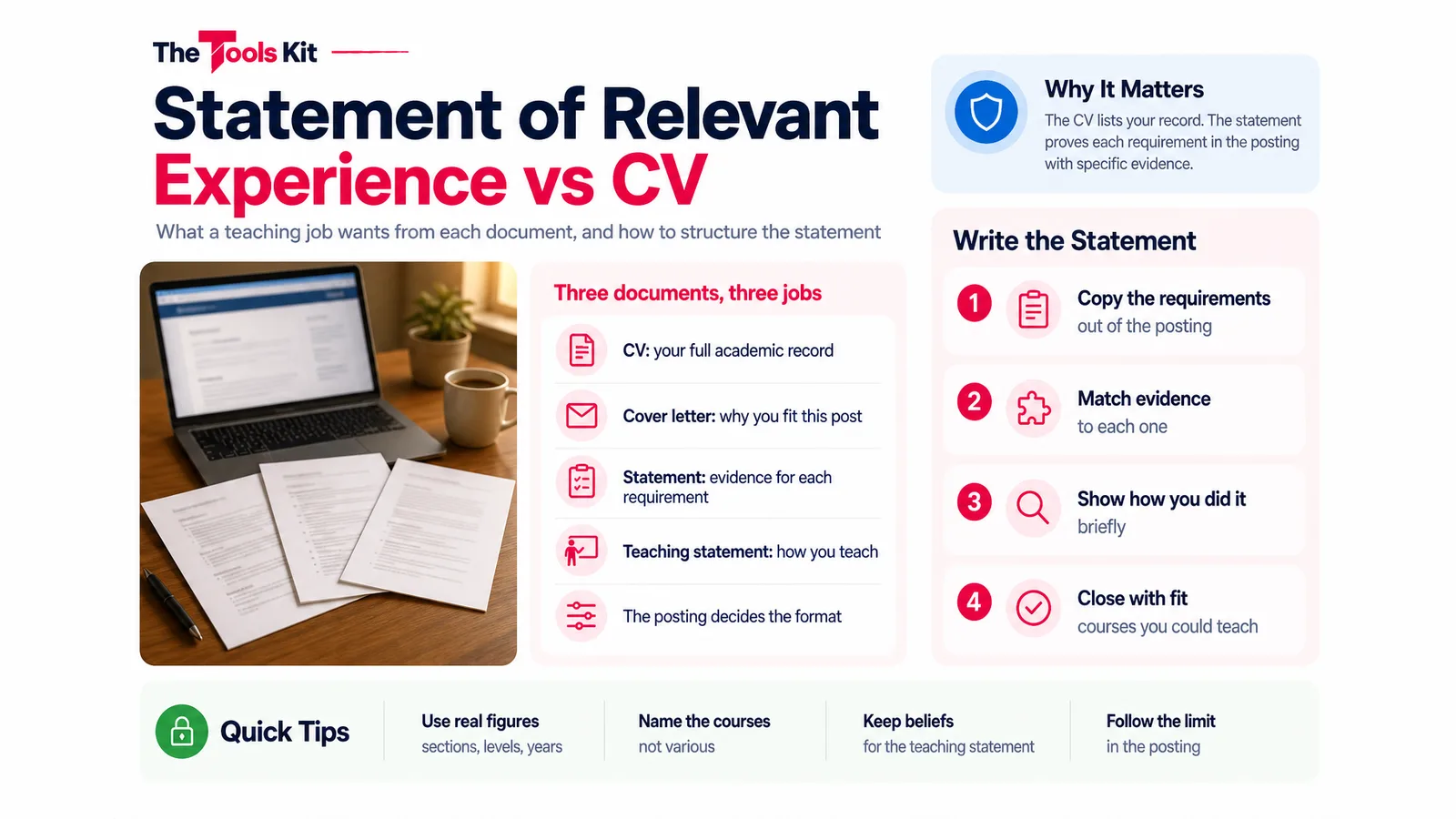
- A statement of relevant experience proves each requirement in the posting with specific evidence; the CV lists your record and the cover letter argues fit.
- Copy the posting's duties and qualifications into a list and use them as headings, answering each with real courses, levels, figures and methods.
- Keep beliefs about teaching for a teaching statement and motivation for the cover letter, so the three documents do not repeat each other.
- Follow the posting's format and length; without a limit, a page or two with headings that match the criteria is usually enough.
A statement of relevant experience is a short narrative that takes the job's stated duties and qualifications and shows, one by one, what you have already done that matches them. Your CV lists your record; your cover letter argues why you want and fit this post; the statement is the evidence file in between. For a non-tenure-track teaching role, most of that evidence is teaching: courses, levels, methods, course design and student support.
Institutions use the phrase differently, so the posting always wins. If it gives a prompt, a list of criteria or a page limit, follow it exactly. If it gives nothing, the structure below is a safe default, and a short email to the contact named in the posting asking what the committee wants is a normal question.
What each document does
Three documents often arrive together, and each has a different job. Repeating the same content in all three wastes the space the committee gave you.
| Document | What it does | Shape |
|---|---|---|
| CV | Lists your full academic record: degrees, appointments, teaching, publications, service | Headings and entries, no argument |
| Cover letter | Argues why you want this post and why you fit it | A letter, usually one to two pages |
| Statement of relevant experience | Proves each requirement in the posting with specific evidence | Short sections that follow the requirements |
| Teaching statement (if asked) | Explains how and why you teach | Reflective prose about your approach |
The Purdue OWL describes the CV as a scholarly identity rather than a professional one, and notes that CVs often run to three or more pages while entry-level resumes are usually one. The CV is the place for completeness. The statement is the place for selection and detail.

Statement of relevant experience vs teaching statement
These are easy to mix up. A teaching statement (or teaching philosophy) is about your beliefs and approach: what good teaching looks like to you and why. A statement of relevant experience is about your record: what you have done, at what level, with what result. If a posting asks for both, keep beliefs out of the experience statement and keep lists of courses out of the philosophy.
How to structure the statement
- Copy the requirements out of the posting. List every duty and qualification, essential and desirable. These become your section headings or paragraph topics, in the posting's order.
- Match evidence to each one. For every requirement, write what you did, where, at what level and for how long. Use your real figures: number of sections, course levels, class sizes, years. Name courses rather than describing them as "various".
- Show how you did it, briefly. One or two sentences on method per item: how you assessed students, what you changed in a course and why, how you supported students who were struggling.
- Add what the CV cannot show. Course redesign, materials you wrote, mentoring, work with a curriculum committee, or industry experience that feeds directly into a course on the list.
- Close with fit. A short paragraph naming two or three courses in the department's catalog you could teach, and at what level.
If a requirement is one you do not fully meet, say what you have that comes closest and keep it short. Leaving it out entirely reads as missing it.
What to leave out
- Your whole CV in sentence form. If a line adds no detail beyond the CV entry, cut it.
- The cover letter's argument. Why you want this particular institution belongs in the letter.
- Research detail for a teaching-focused role, unless the posting lists research or you can tie it to a course.
- Claims without evidence. "Excellent communicator" says nothing; a course you redesigned and what changed says a lot.
Length and format
Follow the posting's limit. Without one, a page or two is usually enough to cover each requirement with evidence, and a committee reading many applications will thank you for headings that match their criteria. Use the same font, margins and header (your name, the job title and reference number) as your other documents, and save it as a PDF unless the portal asks otherwise. A word counter helps when the portal sets a word or character limit.
Tools that help with the other documents
Our cover letter generator lays out a letter from what you type (opening, why you fit, closing) in one of three templates and saves it as a PDF through your browser's print dialog; it does not write content for you. The resume builder makes a resume with experience, education and skills sections, which suits industry or adjunct applications that ask for a resume rather than a full academic CV; it has no publications section. For deciding what belongs where on the CV itself, see where a fellowship goes on a CV or resume and one-page or two-page resume. If the portal gives you an open text box, how long a cover letter should be when there is no limit applies here too.
Sources
Frequently asked questions
It is a short narrative that takes the duties and qualifications in a job posting and shows, one by one, what you have done that matches them. It sits between the CV, which lists your record, and the cover letter, which argues why you fit the post.
The cover letter explains why you want this post and why you fit it, in letter form. The statement of relevant experience is evidence: specific courses, levels, methods and results organized around each requirement. Keep motivation in the letter and evidence in the statement.
No. A teaching philosophy explains your beliefs and approach to teaching. A statement of relevant experience documents your record against the posting's criteria. If both are requested, keep course lists out of the philosophy and beliefs out of the experience statement.
Follow any limit in the posting. When none is given, a page or two is usually enough to answer each requirement with specific evidence. If you are unsure what the committee expects, email the contact named in the posting and ask.